Why a balloon pulls your hair up: the first lesson of Nudge's 'The force you can't see'
Rub a balloon on a sweater and something moves across. Predict what, then watch it happen in a PhET simulation. A walk through the first lesson of Nudge's course on electricity.
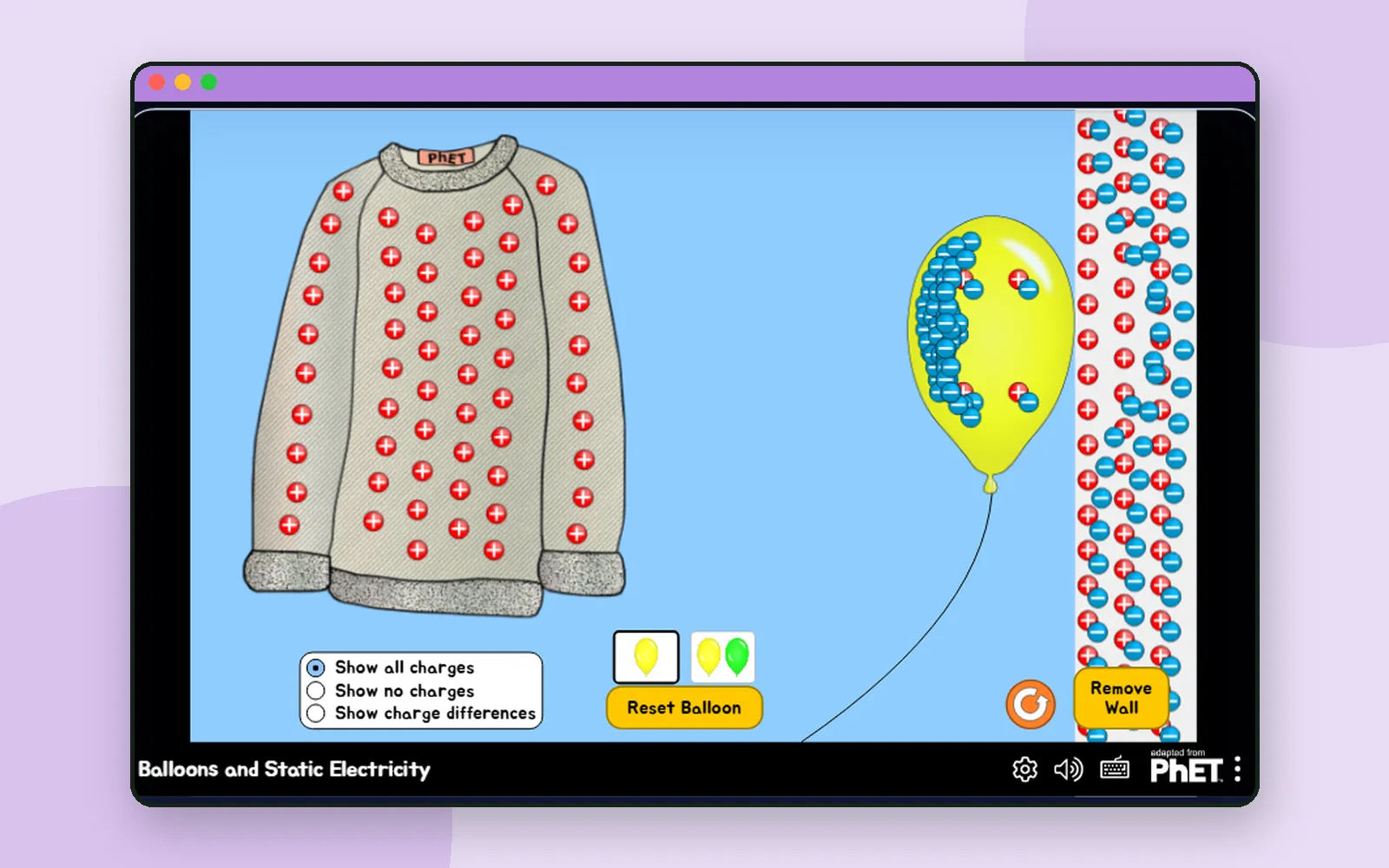
Rub a balloon on your head and your hair rises to follow it. Everyone has seen it. Ask a child why, and you will usually hear “static”, which is a name, not an answer.
Nudge’s course The force you can’t see starts right there. Its first lesson, Why a balloon pulls your hair up, asks one question: when you rub, what actually moves? Here is how it goes. 🎈
The course starts with a balloon
The course sums itself up in one line: you can’t touch it or see it, but it is definitely there. It begins with something every child has done, a balloon and a sweater, before moving on to things you cannot see at all.
Predict first
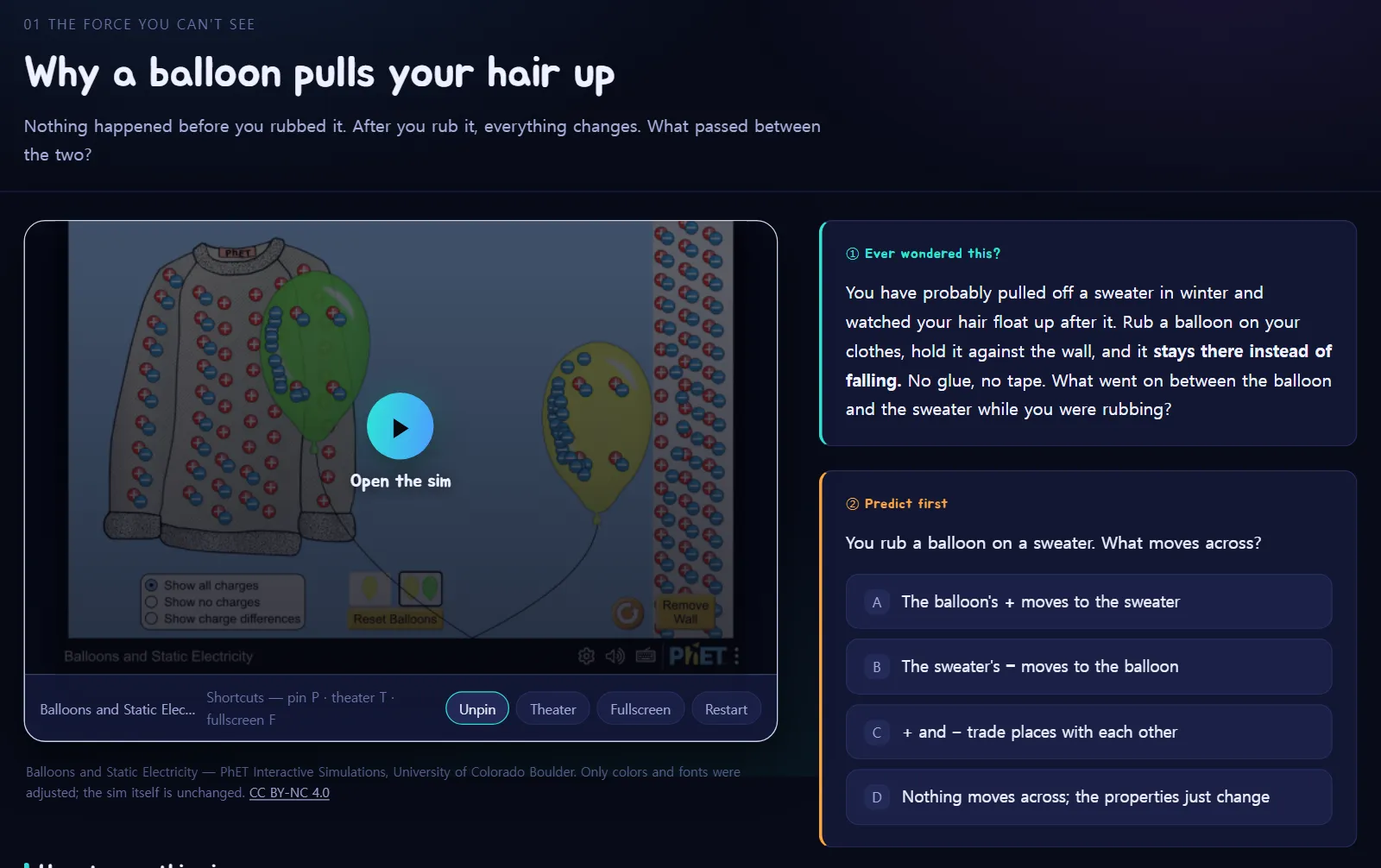
Like every Nudge lesson, this one asks for a guess before the simulation opens. You rub a balloon on a sweater. What moves across?
- A. The balloon’s + moves to the sweater
- B. The sweater’s − moves to the balloon
- C. + and − trade places with each other
- D. Nothing moves across; the properties just change
Rub, and watch the charges move
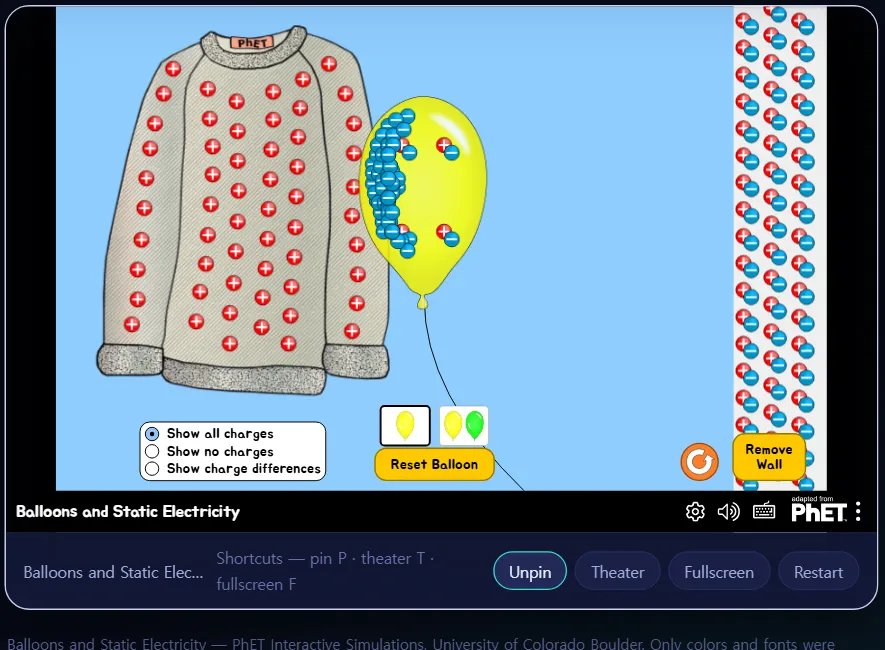
The simulation is Balloons and Static Electricity from PhET. With Show all charges on, the sweater and the balloon each start with + and − sitting in pairs.
Drag the balloon onto the sweater and rub it a few times. You can see the − jump across onto the balloon, while every + stays exactly where it was. Let go, and the balloon drifts back toward the sweater on its own.
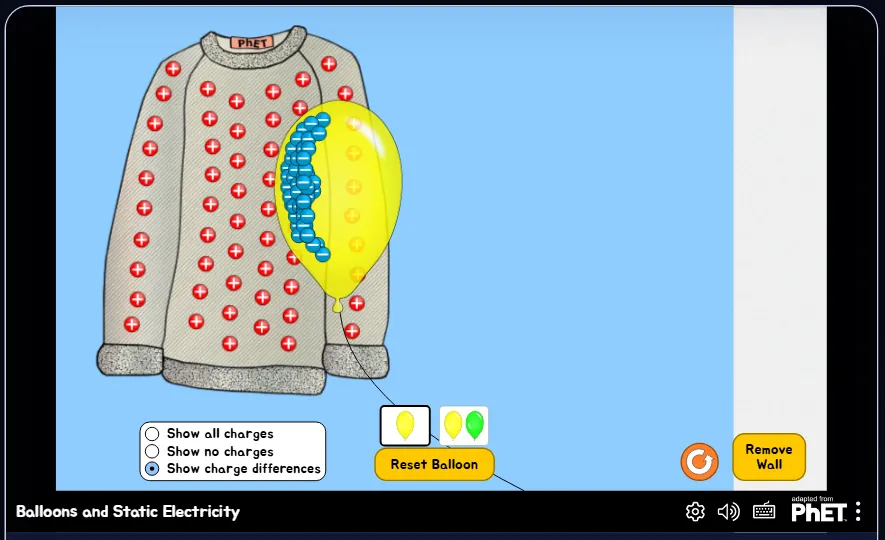
Switch to Show charge differences and the matched pairs disappear. What is left is easy to read: extra − on the balloon, + left over on the sweater.
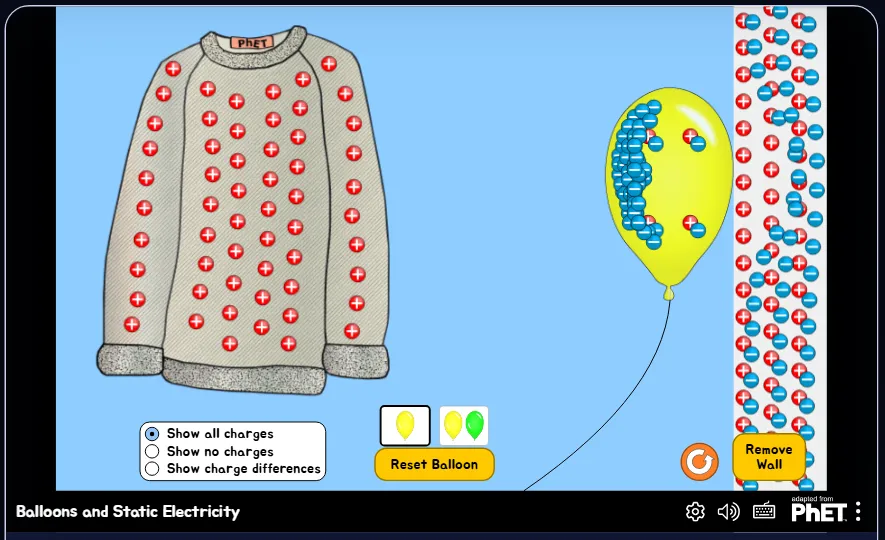
Now bring the balloon close to the wall. Look at the wall’s charges: the − at the surface move back, and the + are left facing the balloon. Nothing arrived and nothing left; the charges only changed seats.
The answer
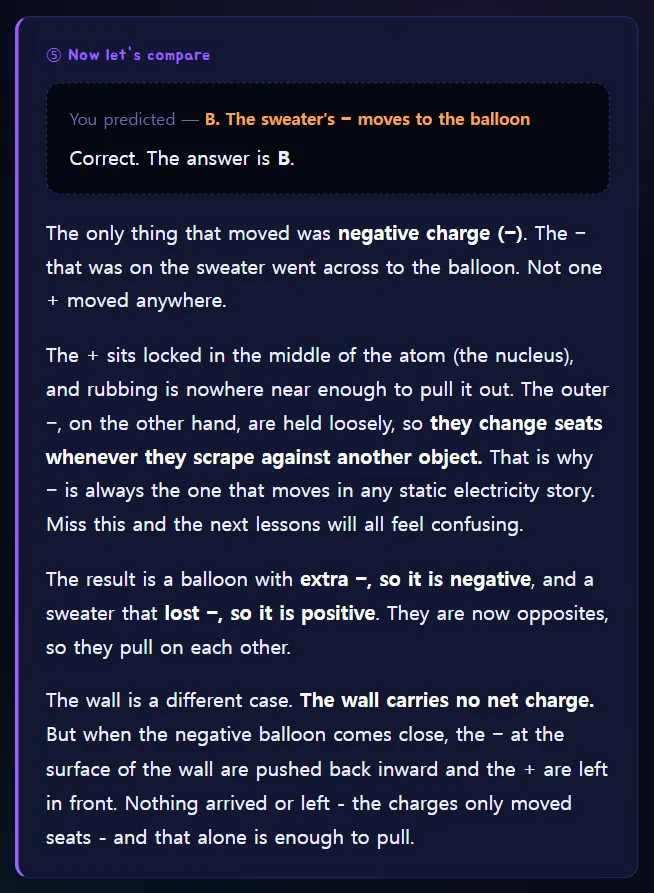
The answer is B. The lesson explains why: the + is locked in the middle of the atom, and rubbing is nowhere near enough to pull it out, while the outer − are held loosely and change seats whenever two things scrape together. So the balloon ends up negative, the sweater positive, and opposites pull.
One line in the explanation is worth reading twice: that is why − is always the one that moves in any static electricity story. Miss this and the next lessons will all feel confusing.
The lesson also connects it to everyday life: the snap from a door handle in winter, and why static is much rarer when the air is humid.
Where the course goes next
That warning is a hint about how the course is built. Each lesson picks up a question the last one left open.
| Lesson | The question it picks up |
|---|---|
| The invisible map drawn around a charge | The balloon never touched the hair. So how did the force get across? |
| Double the distance, and the force becomes what? | You guessed it from arrows. Now check it with numbers, and change one more thing besides distance. |
| Move a magnet and electricity appears | So far electricity made a force. This time it runs the other way. |
Coming up next
New to Nudge? Start with Nudge: predict first, then touch the science, which walks through how every lesson is laid out.
Next time: sharing project files in class, with Scratch for Children 2.
Frequently asked questions
When you rub a balloon on a sweater, what moves?
Only negative charge. Some of the sweater's − moves across to the balloon, and no + moves at all. The balloon ends up negative and the sweater positive, so they pull on each other.
Why does a charged balloon stick to a wall that has no charge?
The wall carries no net charge, but when the negative balloon comes close, the − at the wall's surface are pushed inward and the + are left in front. That shift alone is enough to pull.
Who made the simulation?
It is Balloons and Static Electricity from PhET Interactive Simulations, University of Colorado Boulder (CC BY-NC 4.0). Nudge wrote the lesson around it and adjusted only colors and fonts.
Do I need an account?
No. The lesson and the simulation open in the browser.