Overfitting, explained: the student who memorized the answer key
An AI that aces its practice data and fails on anything new has overfitted. Aha AI explains it with one analogy, then gives you two ways to watch it happen yourself.
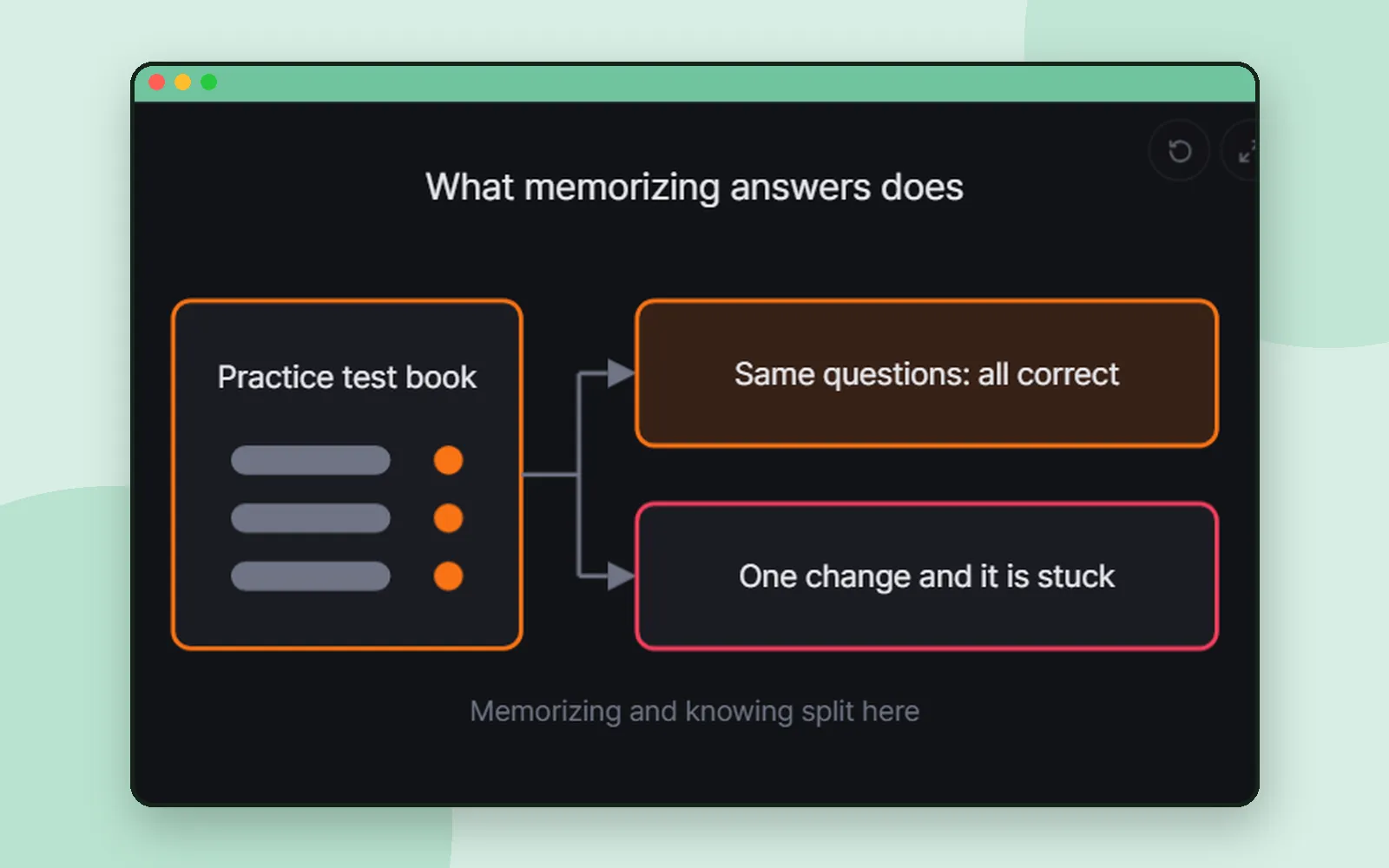
Imagine a student who memorized a whole book of practice tests, answers and all. Question three is B, question seven is D. Inside that book, they cannot miss. Then the real exam changes one detail in a familiar question, and they are stuck.
That student is overfitting, and it is one of the most useful ideas in machine learning to explain to a teenager, or to anyone who uses AI tools. Aha AI builds its whole page on that one analogy. Here is how it works, and how to see it for yourself. 🧠
One line first
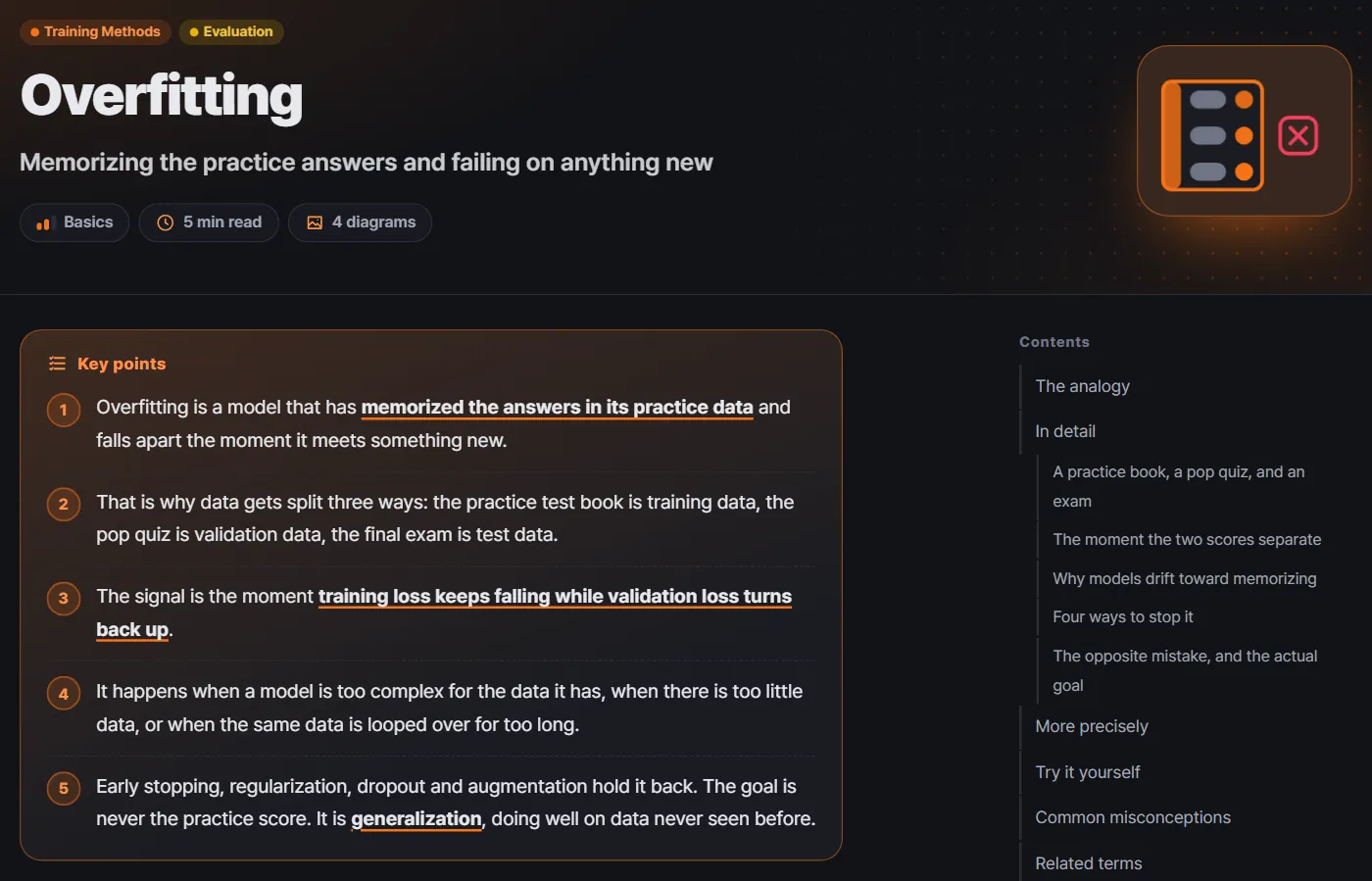
Every Aha AI page starts with a single line. For overfitting it is memorizing the practice answers and failing on anything new. The key points underneath add the part that matters most: a model can be near-perfect on its practice data and still fall apart on something it has never seen.
The analogy: inside the book, memorizing looks like knowing
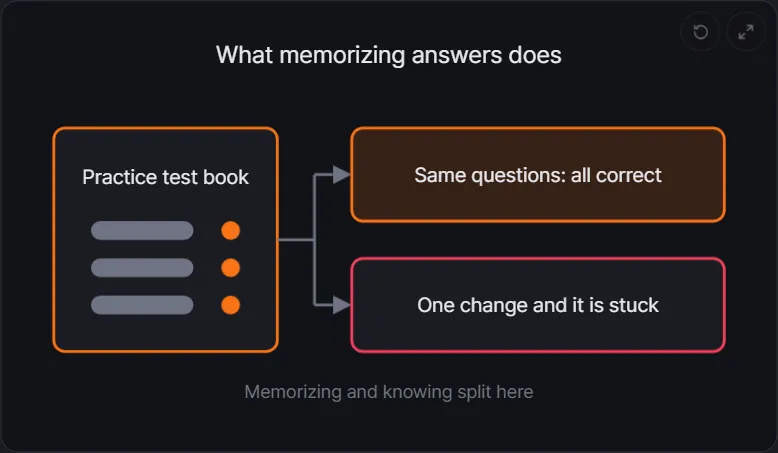
The page follows the student a little further. With every pass through the book, mistakes drop toward zero and confidence climbs. Then one condition changes and they cannot start, because they learned pairs of questions and answers instead of the reasoning behind them.
The sentence worth remembering is this one: inside the book, memorizing and understanding look exactly alike. Only a question the book never contained tells them apart. An AI that has overfitted is in the same state, and its practice score gives no warning.
Practice book, pop quiz, final exam
The analogy carries straight into how AI is actually trained. Aha AI explains it as three piles of data:
| In the analogy | In machine learning | What it is for |
|---|---|---|
| The practice test book | Training data | What the model studies |
| The pop quiz | Validation data | Checked along the way, to decide when to stop |
| The final exam | Test data | Opened once, at the very end |
The pop quiz is the early warning. While the model is learning real patterns, its practice score and its quiz score improve together. When the practice score keeps rising but the quiz score turns down, the model has started memorizing. That is the moment to stop.
Too simple, just right, too tight
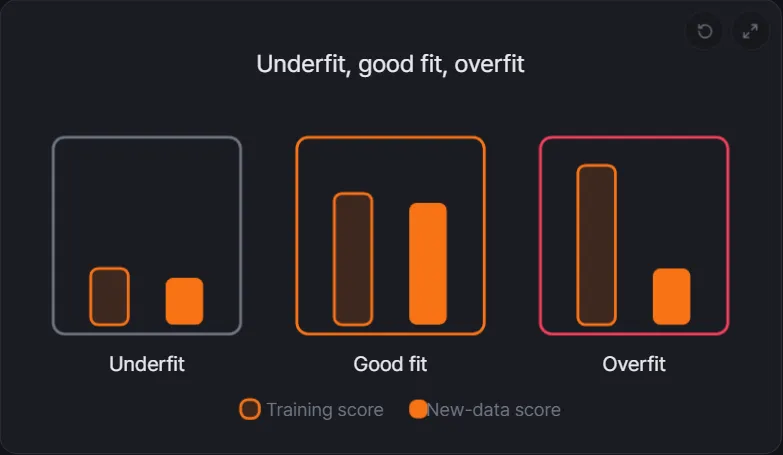
There is a mistake on the other side too. A model too simple to get even the practice data right is underfitting, and that one is easy to spot. What you want sits in between: both scores high and close together. Aha AI’s name for that goal is generalization, doing well on data the model has never seen.
Watch it happen
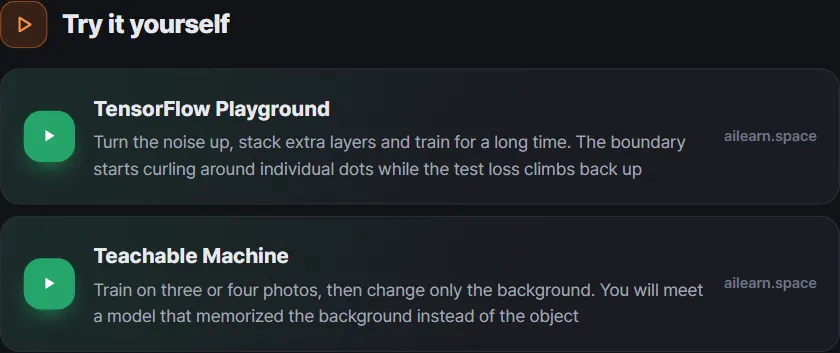
The page ends with two things to try, both introduced on AI Teading:
- TensorFlow Playground. Turn the noise up, stack extra layers and train for a long time. The boundary starts curling around individual dots, while the test loss climbs back up.
- Teachable Machine. Train a model on three or four photos, then change only the background. You may meet a model that learned the background, not the object.
Common misconceptions
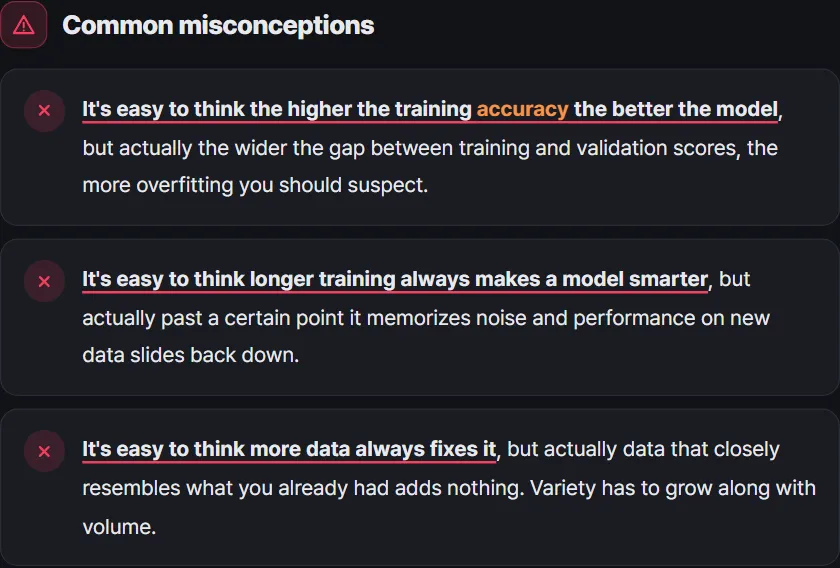
The page closes with a short list of easy mistakes. Two of them are worth saying out loud in a class:
- A higher practice score does not mean a better model. The gap between the practice score and the held-back score is the thing to watch.
- Training longer does not always make a model smarter. Past a certain point it memorizes noise, and its performance on new data drops.
Coming up next
New to Aha AI? Start with Aha AI: one everyday analogy for every AI term.
Next time: writing your own rules for using AI, with chapter 6.4 of AI Teading Teens.
Frequently asked questions
What is overfitting, in one line?
Aha AI puts it as memorizing the practice answers and failing on anything new. The model does brilliantly on the data it practised on, then drops sharply on data it has never seen.
How can you tell a model is overfitting?
Watch two scores during training: one on the practice data, one on data held back. When the practice score keeps improving but the held-back score turns worse, the model has started memorizing.
Doesn't more training always help?
No. Past a certain point the model starts memorizing noise and quirks in its data, and its performance on new data slides back down.
Can a child see overfitting happen?
Yes. The Aha AI page suggests two hands-on tools: TensorFlow Playground, where the boundary starts curling around individual dots, and Teachable Machine, where a model trained on a few photos learns the background instead of the object.