Teadium: a science museum you open with code
Teadium is an online science museum from CodingTeading. Each exhibit has three steps: see real data, understand it with a moving drawing, then make it yourself with blocks or JavaScript.
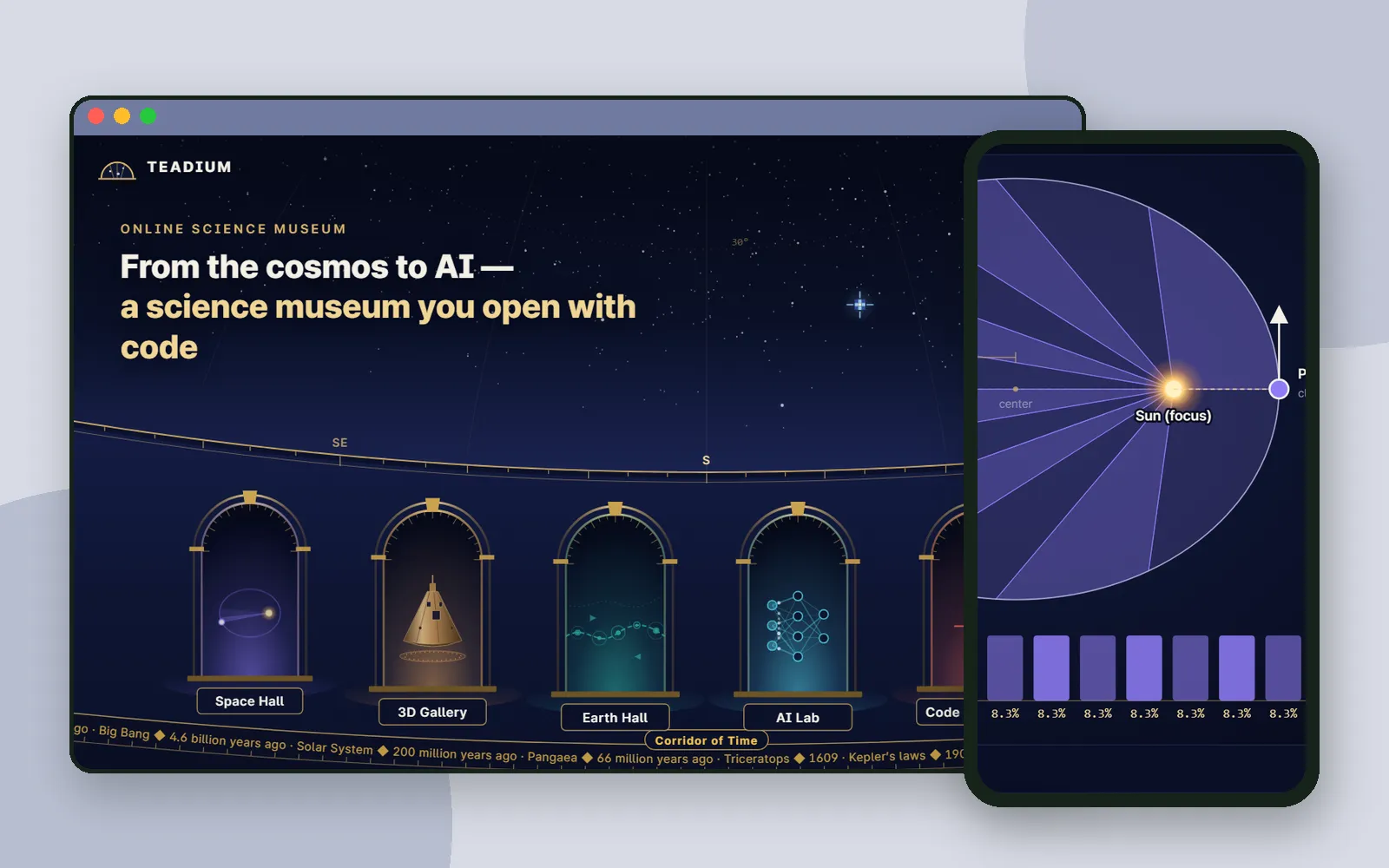
Why does a planet speed up as it nears the Sun? You could read the answer in a sentence. At Teadium, you watch it happen, see why it happens, and then build a planet of your own to check. 🪐
Teadium is a new online science museum from CodingTeading. Its own headline: From the cosmos to AI — a science museum you open with code.
A domed hall with doors
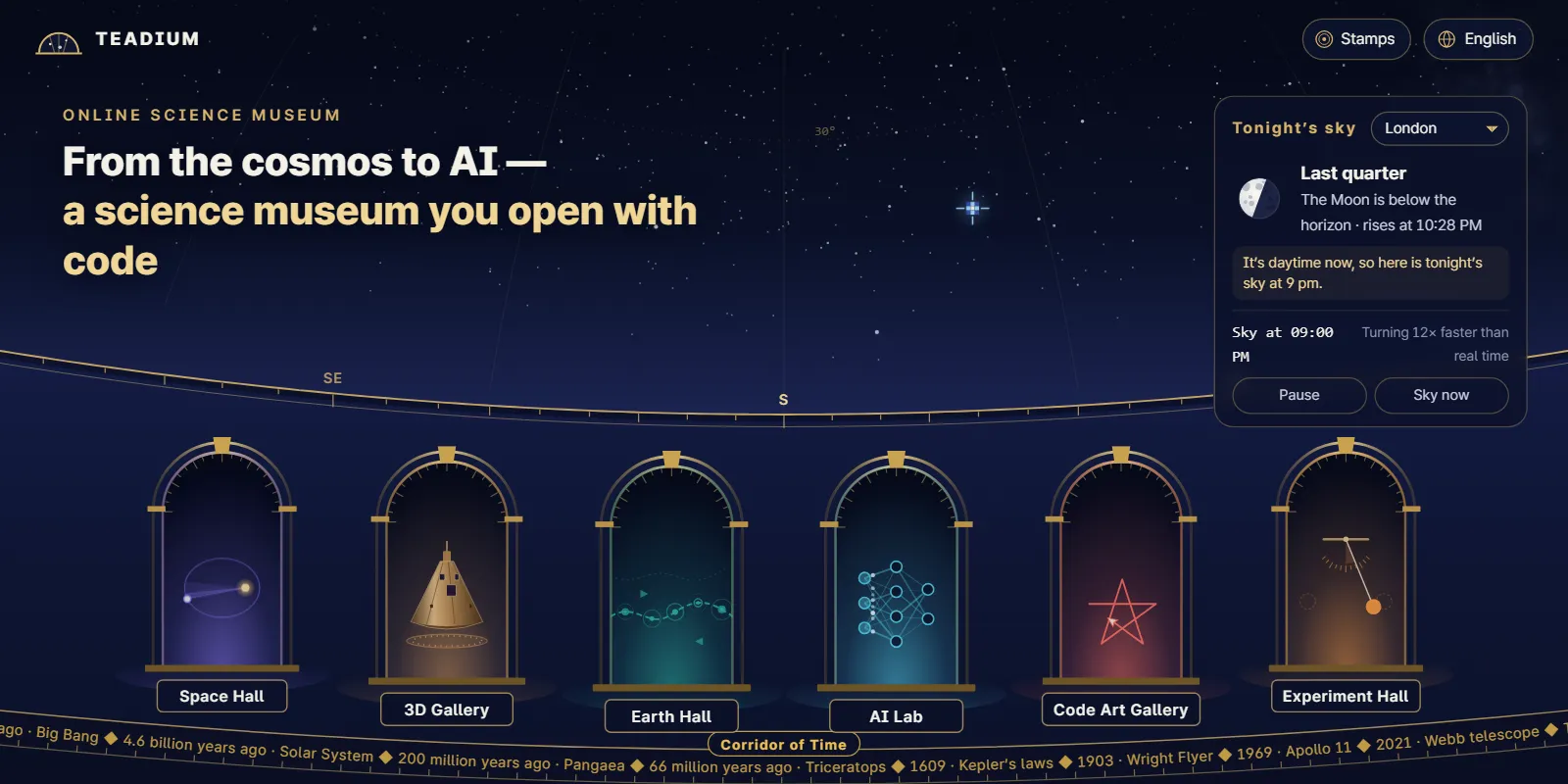
You arrive in a central hall under a dome of stars. Along the bottom is a row of arched doors: Space Hall, 3D Gallery, Earth Hall, AI Lab, Code Art Gallery and Experiment Hall. The band of dates running underneath the arches is the way into the Corridor of Time, which places every exhibit on one line from the Big Bang to today.
The Tonight’s sky box in the corner is worked out for today and changes with the date and the city you choose.
A small round robot in the corner is Teadi, your guide. Teadi greets you in the hall and, inside the exhibits, offers a hint for whichever step you are on.
See, Understand, Make
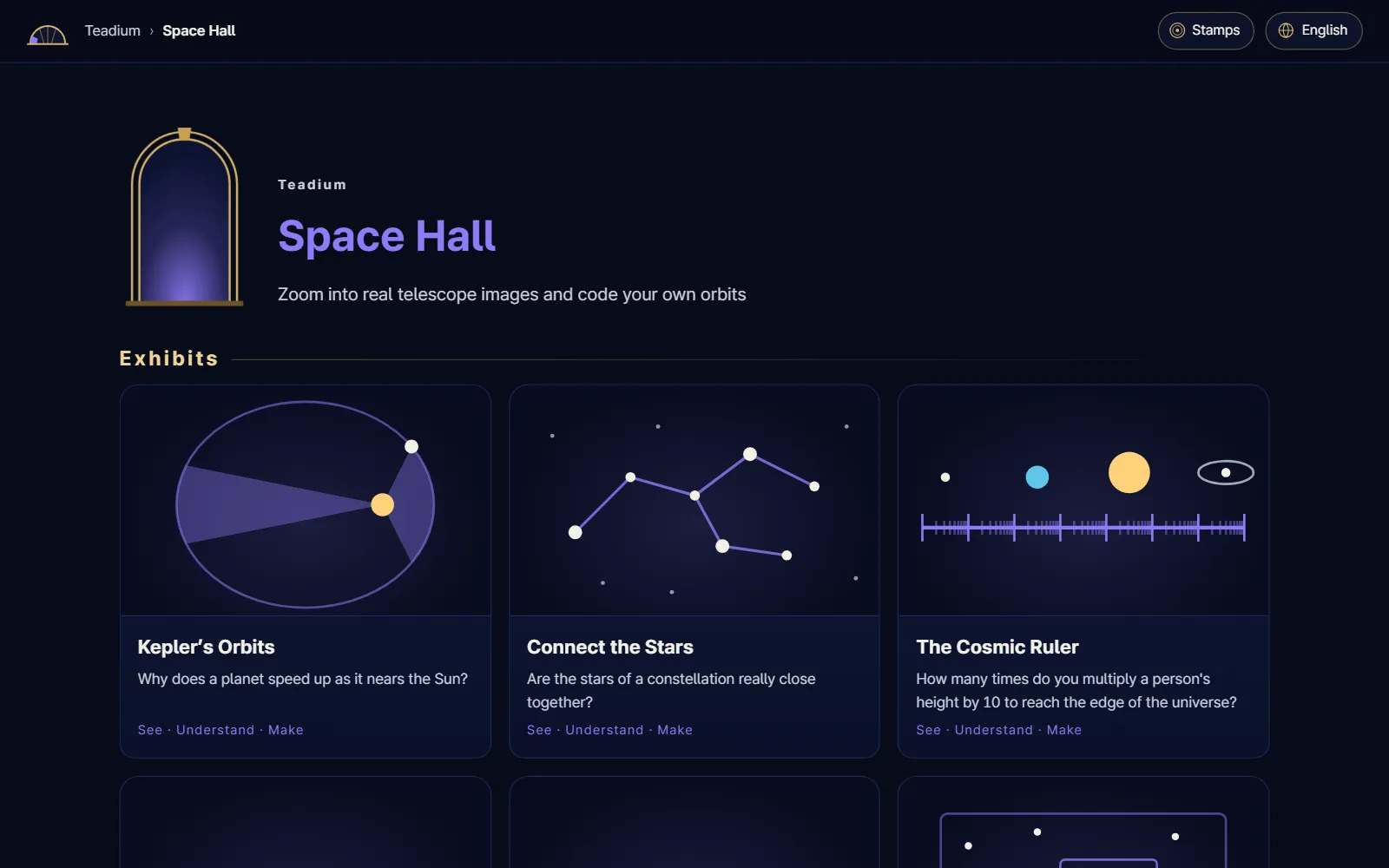
Every exhibit card carries the same three words: See · Understand · Make. That is the shape of a visit here. First you look at real data, then a drawing that moves explains it, and finally you build something yourself.
We followed one exhibit all the way through: Kepler’s Orbits in the Space Hall.
See: the real orbits
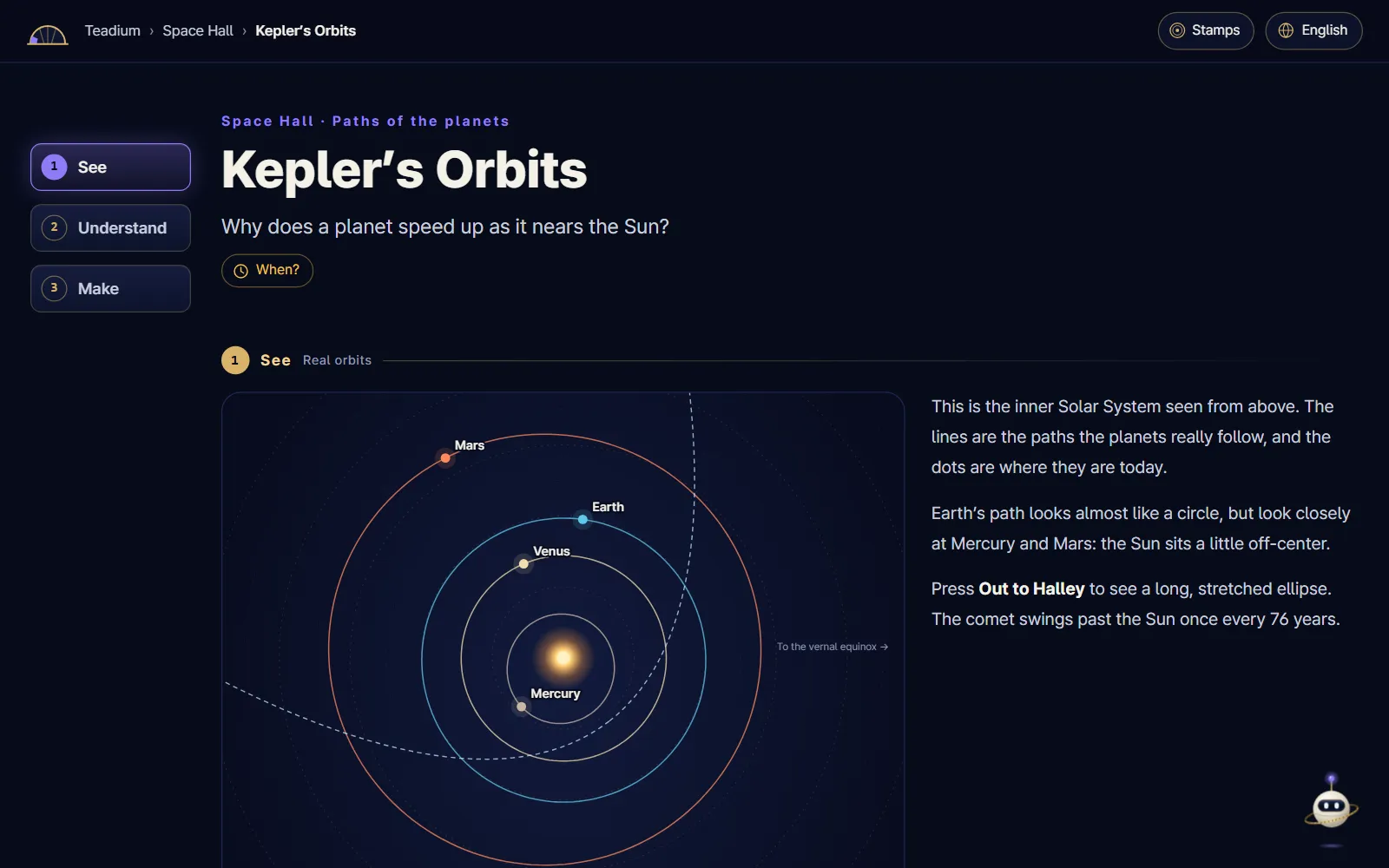
The exhibit opens with its question, Why does a planet speed up as it nears the Sun? Below it are the inner planets, drawn from orbital elements published by NASA JPL, with time running. Earth’s path looks almost like a circle. Look closely at Mercury and Mars, though, and the Sun is a little off-center. Press Out to Halley and a long, stretched ellipse appears.
Understand: equal times, equal areas
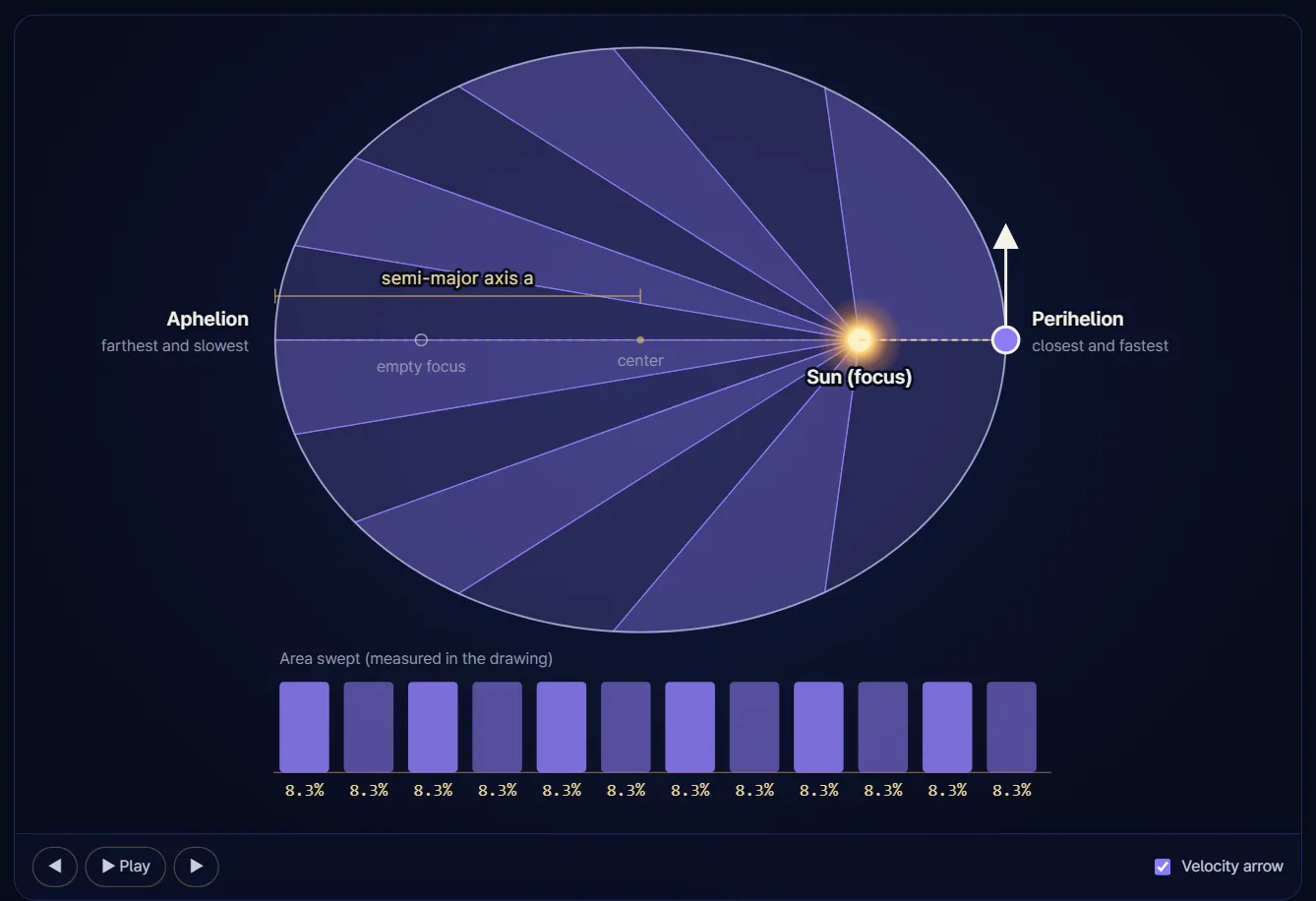
Here a planet travels round one strongly elliptical orbit. In each equal stretch of time, the line from the Sun to the planet sweeps out a wedge, and a bar below measures each wedge’s area. Near the Sun the wedges are short and wide; far away they are long and thin. The bars are all the same height.
When we reached this step, Teadi spoke up first: Look at the bars. The wedges all have different shapes, but the bars are the same height.
That is Kepler’s second law, which Johannes Kepler worked out in 1609 from observations of Mars. The exhibit explains it with a string: near the Sun the string is short, so the planet has to travel farther to sweep the same area. That is why it speeds up.
Make: a planet of your own
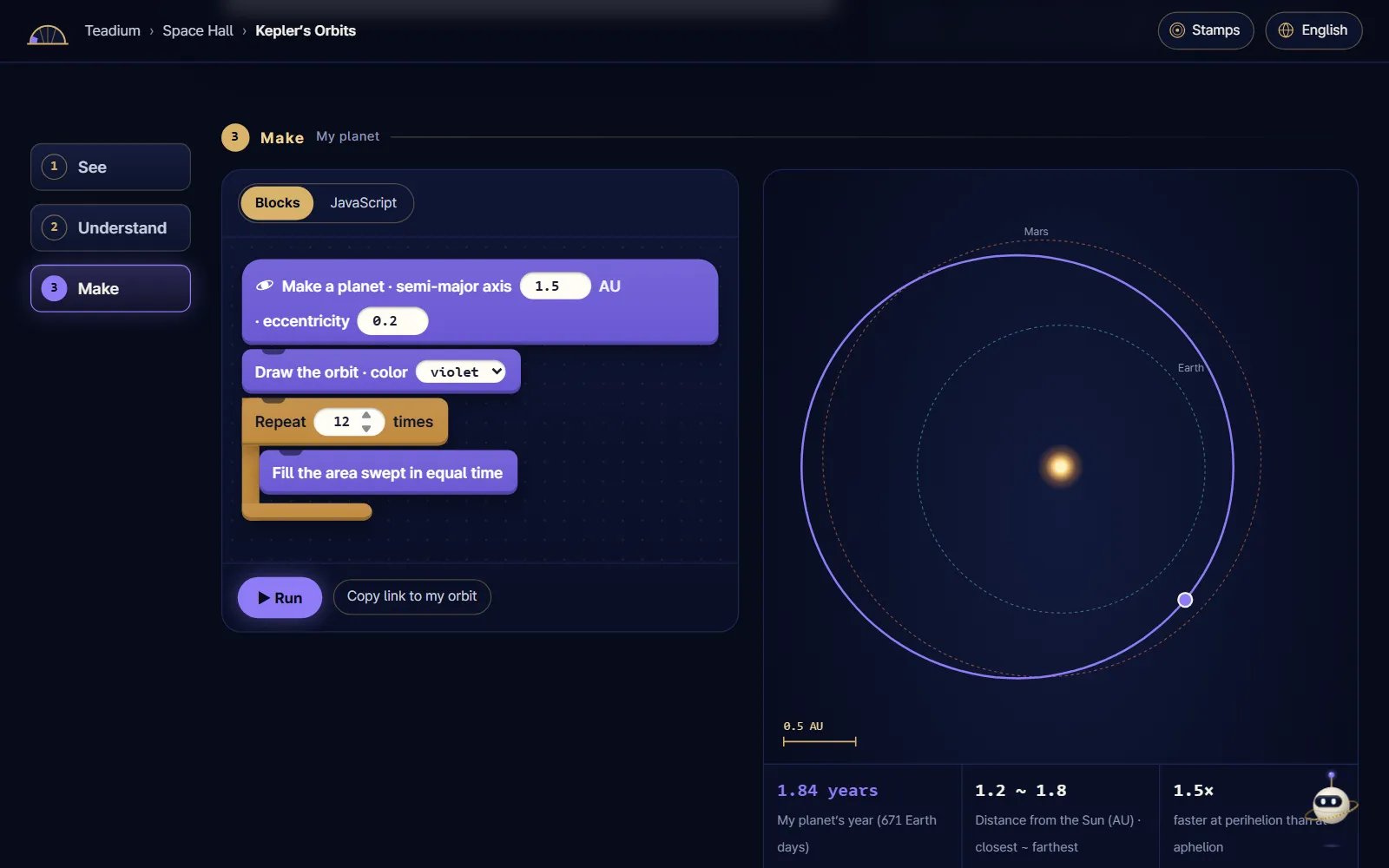
The last step hands it over to you. The blocks read Make a planet with a semi-major axis and an eccentricity, Draw the orbit, and Repeat, with Fill the area swept in equal time inside. Press ▶ Run and your planet goes round, painting its wedges.
After the first run, Teadi suggests the next experiment: Try raising the eccentricity to 0.9. So we did.
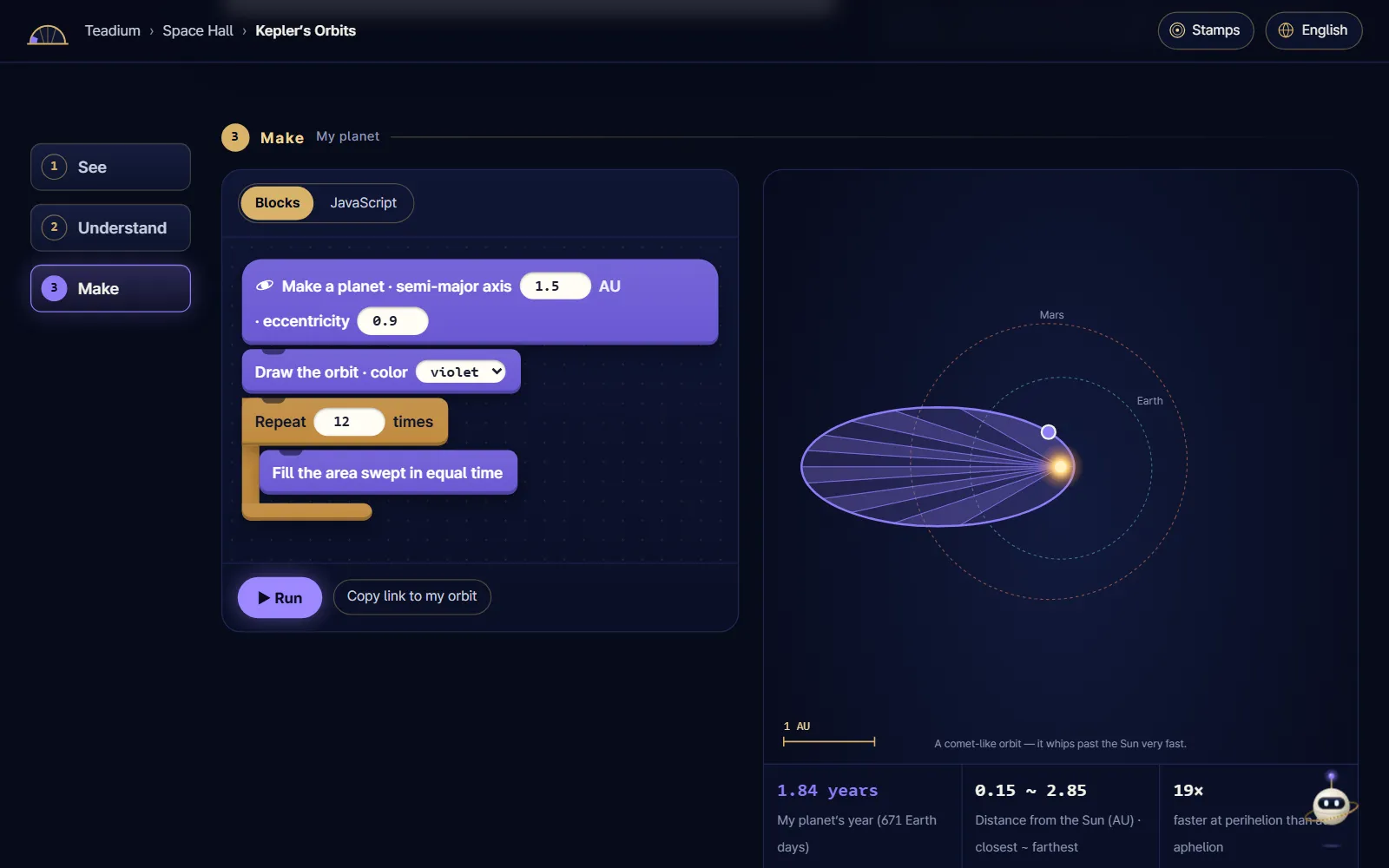
The orbit stretches into a long ellipse, and the note under it says A comet-like orbit — it whips past the Sun very fast. The numbers below showed our planet moving 19 times faster at its closest point than at its farthest. Its year stayed the same, because we had not changed the semi-major axis. That is the third law peeking through.
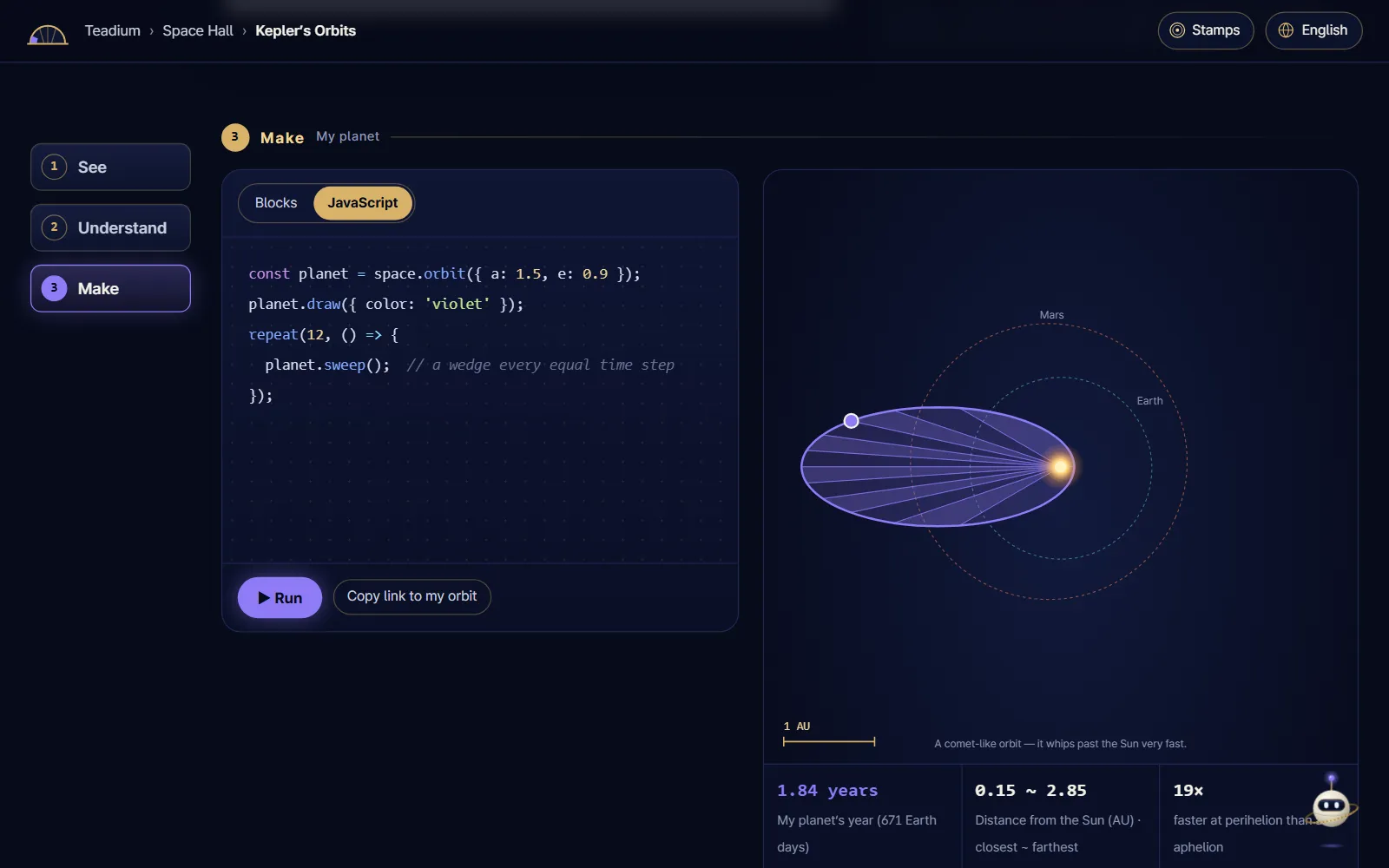
The JavaScript tab shows the same program as code, with the values you set in the blocks. Switch back and the blocks are still there. That makes it a gentle first look at text code for anyone who has only used blocks.
A stamp for every hall
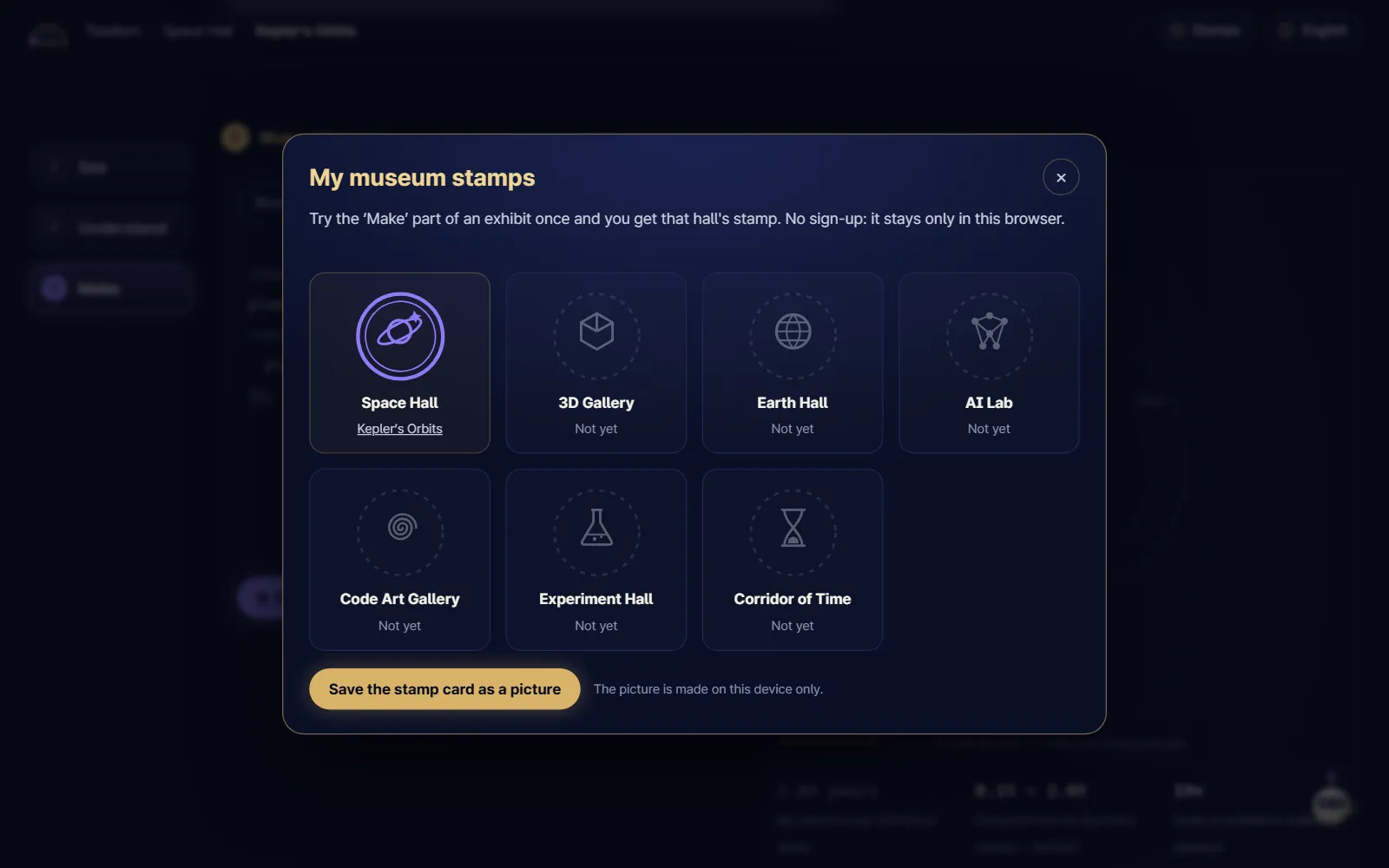
Do the Make step of an exhibit once and that hall gets a stamp on your museum stamps card. As the card itself says, there is no sign-up, and the stamps stay only in this browser.
Coming up next
Want the bigger picture of CodingTeading’s apps? See Meet CodingTeading.
Next time: Ddolbeng Rolls, a block-coding puzzle adventure you can play without reading.
Frequently asked questions
What is Teadium?
An online science museum that opens in the browser. You start in a domed central hall and walk into halls on space, Earth, AI, code art and more. Each exhibit has three steps: See, Understand and Make.
Who is it for?
The site describes itself as a place for children and students, parents and teachers, and adults who like science. The Make step uses blocks, and you can switch the same program to JavaScript.
Do you need an account?
No. There is no sign-up, and your progress and settings stay in your browser.
Where do the photos and data come from?
From openly published sources, such as orbital elements released by NASA JPL. Every outside source is listed on the site's Sources & credits page with the credit line its publisher asks for.