Zoomputer: zoom into a computer until you reach the switches
Zoomputer starts at a laptop and keeps zooming in: a real chip photo, then explanatory drawings of transistors and logic gates. On the way, an if-statement from block code turns into a circuit.

What is actually inside a computer? Zoomputer answers by zooming in. It starts with a laptop on a desk and keeps going: into the chip, past the transistors, down to the tiny switches that make every decision. Its own tagline: Into the computer, all the way down. 🔍
Meet Bity, and start zooming

Your guide is Bity, an electron. Hi, I am Bity, an electron. Shall we go all the way inside this laptop? At the bottom are three buttons: Zoom in, Zoom out and All the way down. A ladder on the right shows the floors you will pass, from L0 Laptop through Chip, Transistor and Logic gates up to L11 AI.
The gauge in the corner keeps track of the scale, switching from centimetres to millimetres, micrometres and nanometres as you go.
Where the photos stop
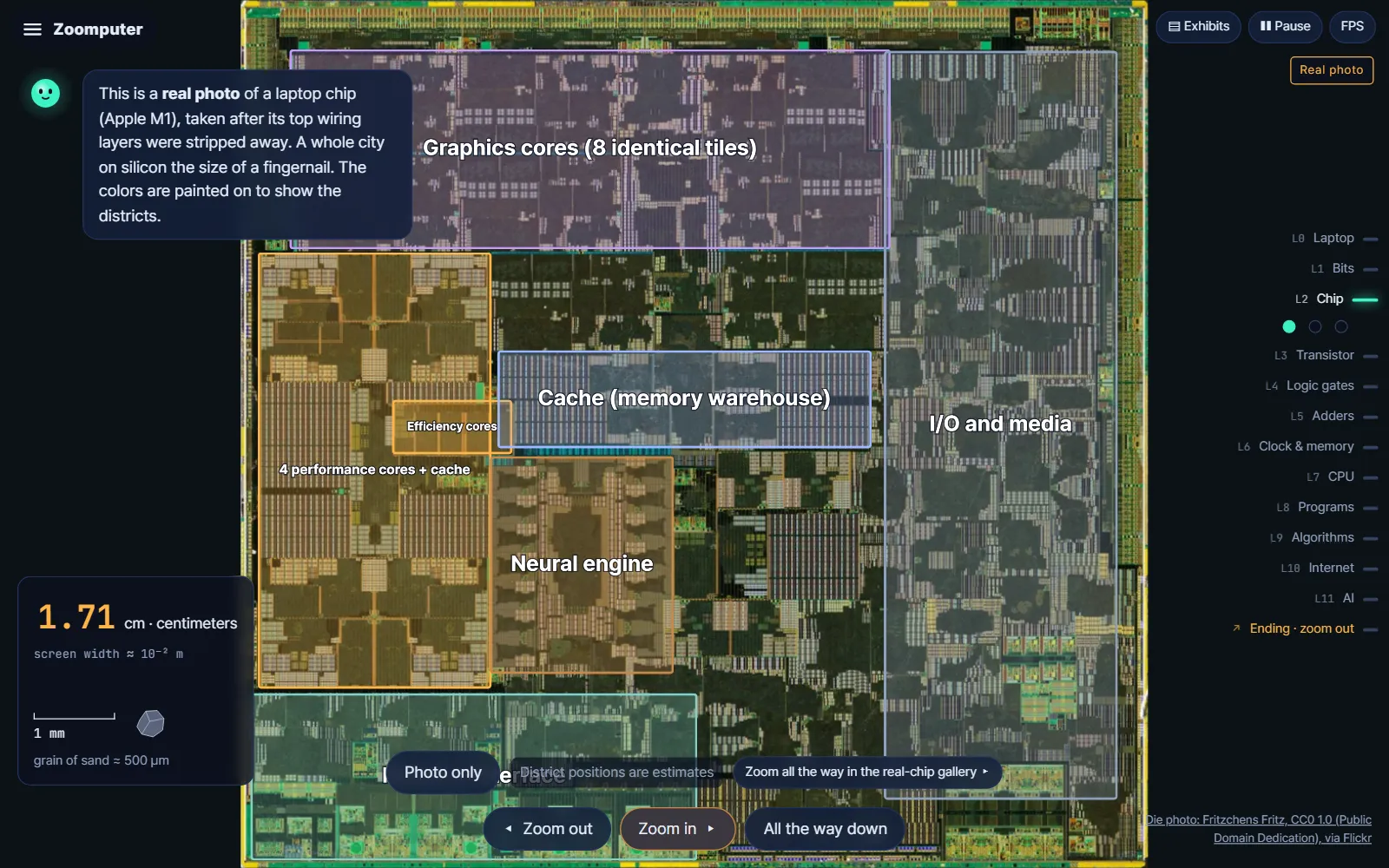
Press Zoom in a few times and you reach the chip. Bity explains: This is a real photo of a laptop chip (Apple M1), taken after its top wiring layers were stripped away. The colours are painted on to show the districts, and a note under the photo says plainly: District positions are estimates. (Die photo: Fritzchens Fritz, CC0 1.0, via Flickr.)
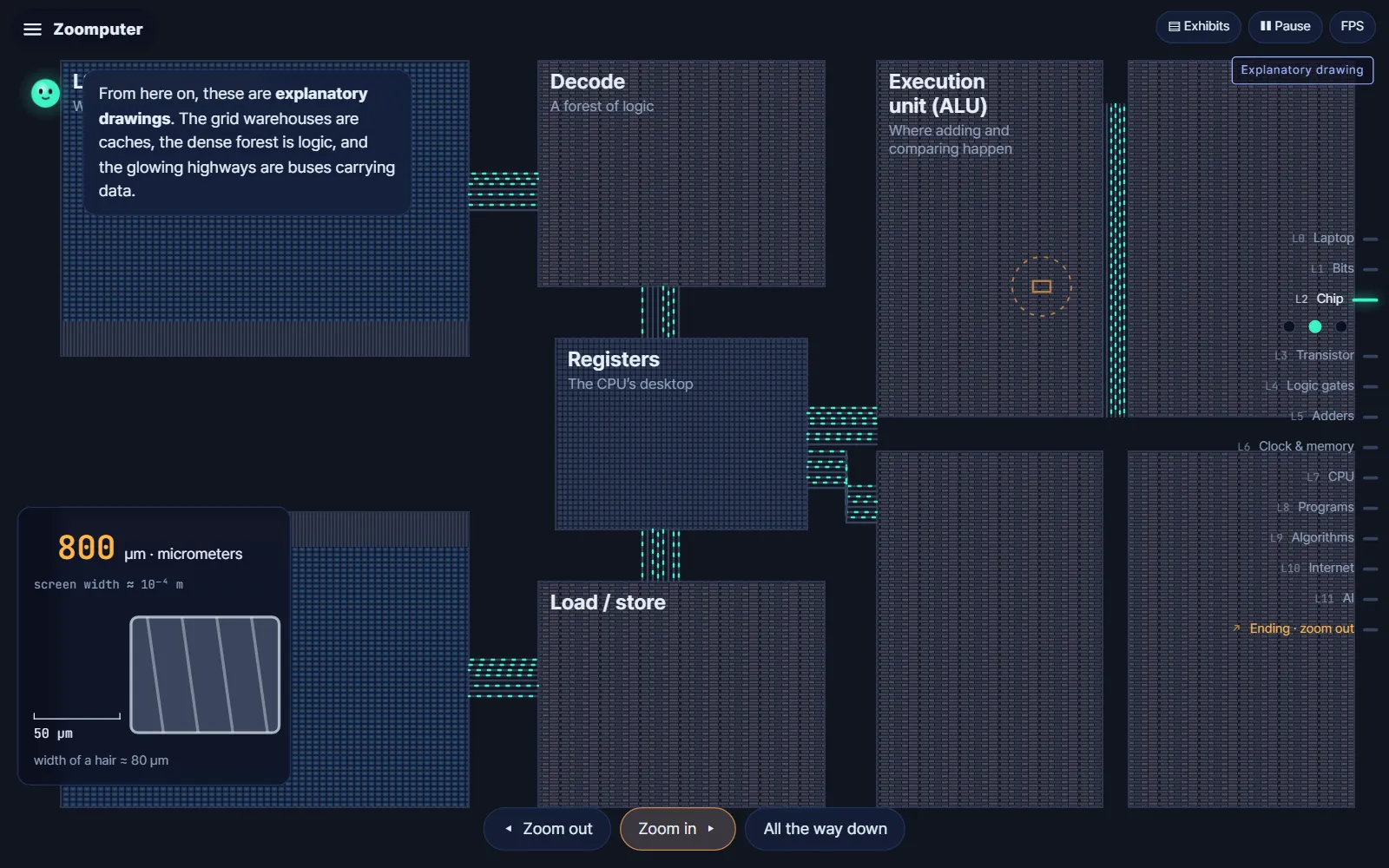
One more step, and the label in the corner changes from Real photo to Explanatory drawing. Bity says so too: From here on, these are explanatory drawings. Parts this small can’t be photographed with ordinary light, so the site shows clearly where the photographs end and the drawings begin.
That is worth pointing out to a child: knowing which picture is a photo and which is a diagram is part of reading science.
Two switches make a decision
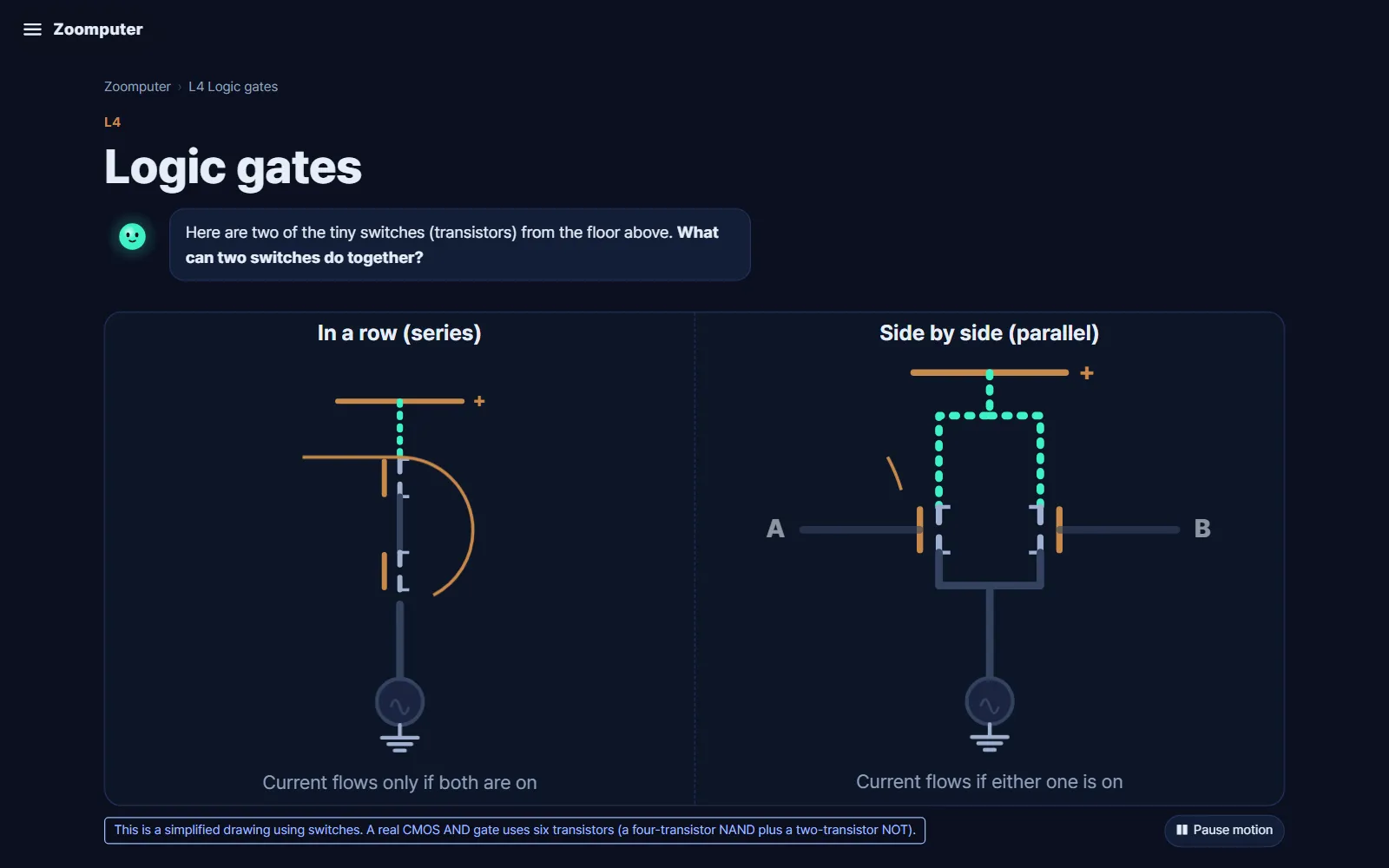
Further down, on L4 Logic gates, Bity asks: What can two switches do together? Put two switches in a row and current gets through only if both are on: that’s an AND gate. Put them side by side and either one will do: that’s OR.
The floor is honest about the simplification: This is a simplified drawing using switches. A real CMOS AND gate uses six transistors.

In the Gate playground, an AND gate is already wired to switches A and B and a lamp, Y. Bity asks: Do both have to be on to light lamp Y? We turned B on, and with A already on, the lamp lit. The truth table on the right highlights the row for the current inputs, 1 · 1 → 1. Challenges along the top, such as Exactly one, ask you to build a circuit that matches a rule.
When a block becomes a circuit

This is the exhibit that ties it all together for anyone who has used block coding. On the left, a block says if a and (not b), turn the lamp on. Under it, the same condition in JavaScript: if (a && !b). On the right, the circuit that computes it: b goes through a NOT gate, then an AND gate checks it together with a.
Change the block, and the code, the circuit and the truth table all change with it.

Under Try one, we picked not (a and b), then (not a) or (not b). The circuits look different, but the truth tables match row for row. The page names the idea, Same truth table, different circuit: it’s De Morgan’s law.
Coming up next
Next time: Mathium, a museum where you see why the math is true.
Frequently asked questions
What is Zoomputer?
A journey into a computer that opens in the browser. You start at a laptop and zoom in floor by floor, from L0 Laptop to L11 AI, with exhibits to try on each floor.
Are the close-ups real photos?
Only down to the chip itself. The chip scene is a real die photo, labelled Real photo. Everything deeper is labelled Explanatory drawing, because those parts are too small to photograph with light.
How does it connect to block coding?
On the logic gates floor, the Blocks ↔ circuit exhibit shows an if-block, the same condition in JavaScript, and the gate circuit that computes it, all changing together.
Do you need an account?
No. There is no sign-up, and progress stays in your browser.