Three lines of your own: the last chapter of AI Teading Teens
AI Teading Teens ends by handing teenagers three tests and asking them to write three rules: what to hand over, what to do themselves, and what to always check.
Most guides to AI for teenagers end with a list of dos and don’ts. AI Teading Teens ends differently. Its last chapter, Your own rules for AI, hands over three tests and asks readers to write the rules themselves.
The opening sets it up in a couple of lines: You’ve come a long way. One thing left — how will you use it? ✍️
The last chapter
Chapter 6.4 closes Part 6 · Living with AI. By this point the book has covered photos as numbers, learning as correcting mistakes, guessing the next piece of text and making pictures out of mess. The chapter does not add another topic. It asks what you will do with all of it.
Three tests
The tests have been building up through the book. The chapter gathers them in one place:
| Test | Where it came from | What it guards against |
|---|---|---|
| Can I check the result? | Chapter 4.5 | Handing over something you cannot check, then believing the answer |
| Is there someone answerable when it goes wrong? | Chapter 6.1 | Not knowing who can put it right |
| Is this something I get better at by doing? | New in this chapter | Getting the result but not getting stronger |
The third test is the interesting one. The chapter asks why we still learn multiplication when calculators exist, and answers that some things only grow by doing them: writing, working a problem through, trying again after getting it wrong. Let an AI do them and you still get the result, but you do not get stronger.
One way it might split
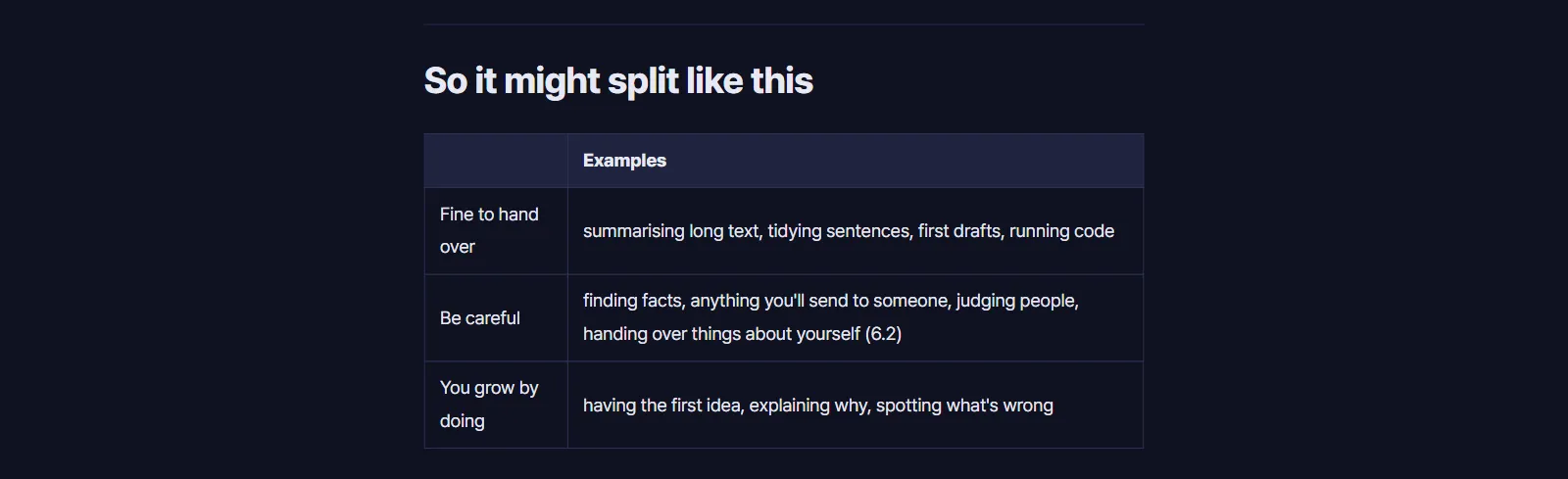
Then the chapter puts the tests to work on everyday tasks:
- Fine to hand over: summarising long text, tidying sentences, first drafts, running code
- Be careful: finding facts, anything you will send to someone, judging people, handing over things about yourself
- You grow by doing: having the first idea, explaining why, spotting what’s wrong
And straight after the table: That’s where this guide landed. Yours may be different. That line is the whole point of the chapter.
Write your three lines
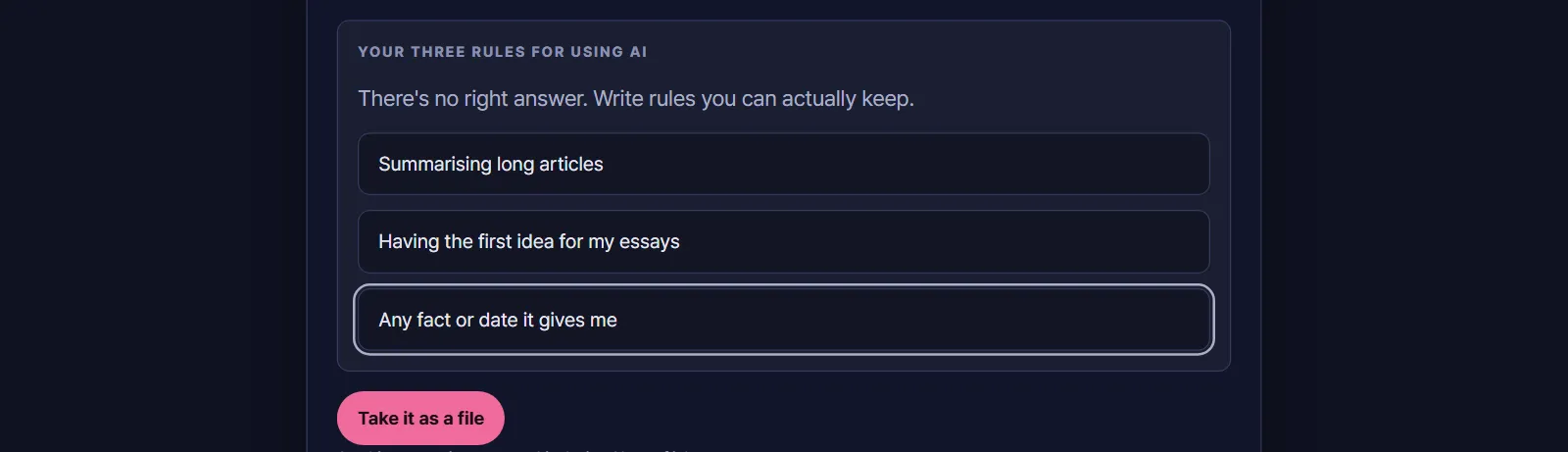
In lab P22, readers write their own three rules:
The rules in the picture are examples we typed in, not the book’s. The chapter explains why it asks for your own: rules handed to you rarely stick. When you are done, Take it as a file saves them so they can go with you.
The same lab also gathers what readers wrote earlier in the book, such as the prediction from chapter 1.3 about what AI would be doing in ten years. It is a good moment to read it again.
What comes next
The chapter ends by looking ahead, carefully. People’s predictions about AI have often missed, it notes, so this one could too. But one difference seems to hold: AI keeps getting better at making answers, while setting the question is still up to people.
Its last word is about tone. The book was not written to make readers wary of AI; it was written so they would know what it is before they use it. Not knowing, it looks remarkable. Knowing, it looks like a tool.
Coming up next
For the whole book and how it’s organised, see AI Teading Teens: a hands-on book about how AI works. For a chapter from earlier in the book, read From mess to picture: how a picture-making AI actually draws.
Next time: AI you play with a webcam, a hands-on course from AI Teading.
Frequently asked questions
What does chapter 6.4 of AI Teading Teens ask readers to do?
To write three rules for using AI: what they will hand over, what they will do themselves because that is how they grow, and what they will always check first.
What are the three tests?
Can I check the result? Is there someone answerable when it goes wrong? Is this something I get better at by doing?
Does the book give the right rules?
No. It shows one way the tests might split everyday tasks, then says yours may be different. The point is that teenagers write their own.
How can a parent or teacher join in?
The chapter suggests showing your three rules to a grown-up, asking for theirs, and perhaps setting one rule together for the house.