Mathium: a math museum where you see why it's true
Mathium is a math museum of moving pictures. Watch five pieces prove the Pythagorean theorem, then play the Monty Hall game, run it 1,000 times and see why an experiment isn't a proof.
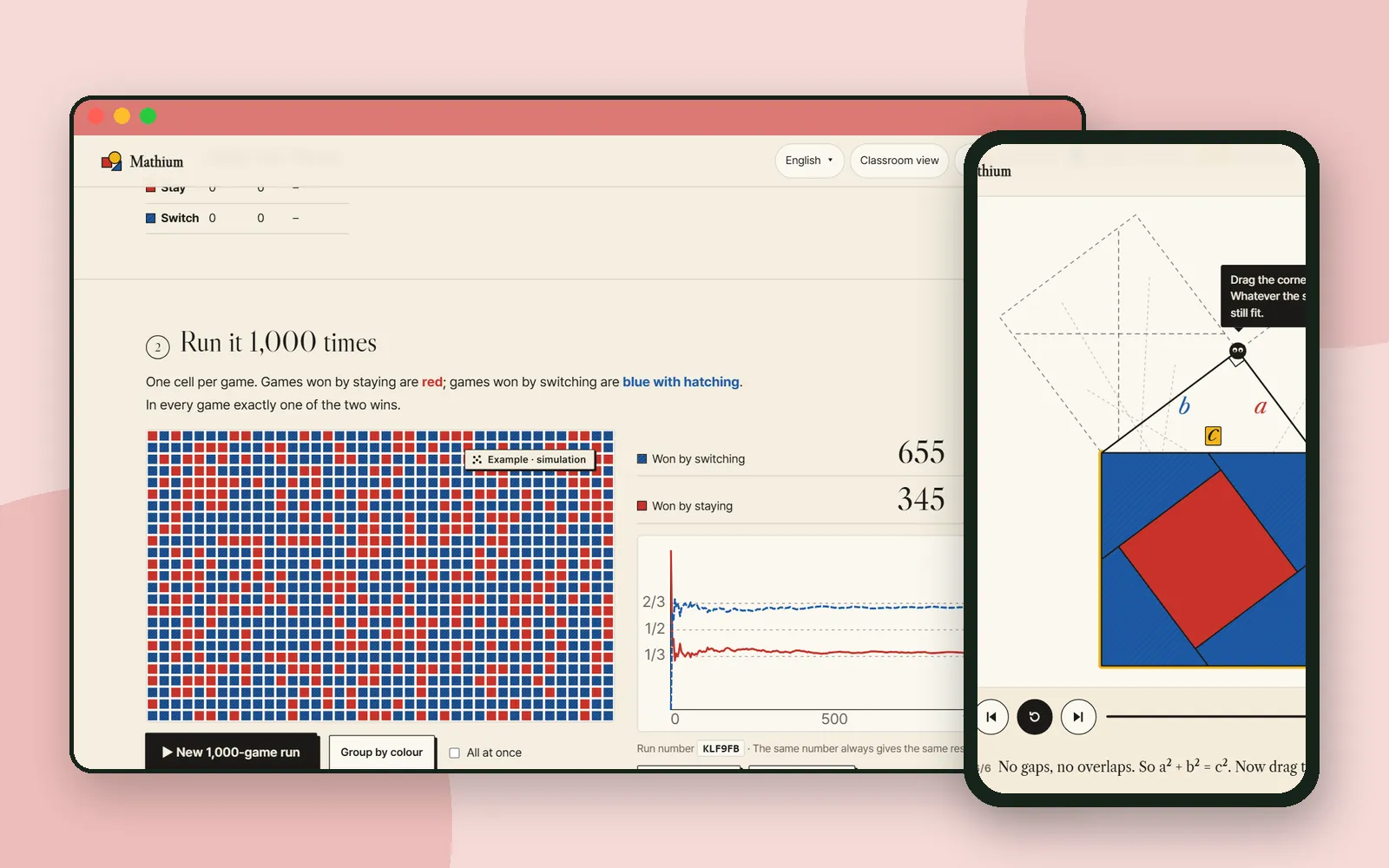
Most of us were taught that a² + b² = c². Fewer of us were ever shown why. Mathium is built for exactly that gap. Its tagline: Math you understand the moment you see why. 📐
A museum made of shapes

The front of the museum is itself built from solids: cylinder columns, a triangular pediment, a half-sphere dome and a golden-rectangle door. Press Enter and you’re in the lobby, where the first exhibit is already moving.
Before looking at any exhibit, it helps to know one thing about this museum. Every scene wears a badge that says what kind of picture it is:
- Proof: it shows that something is true in every case.
- Limit intuition: it shows something getting closer and closer, which on its own isn’t a proof.
- Example · simulation: a worked example or an experiment.
- Unsolved: nobody knows the answer yet.
- Lying picture: a picture that looks convincing but is wrong.
That small label is a lesson in itself: in maths, “I saw it work” and “I showed it always works” are different things.
Five pieces that always fit
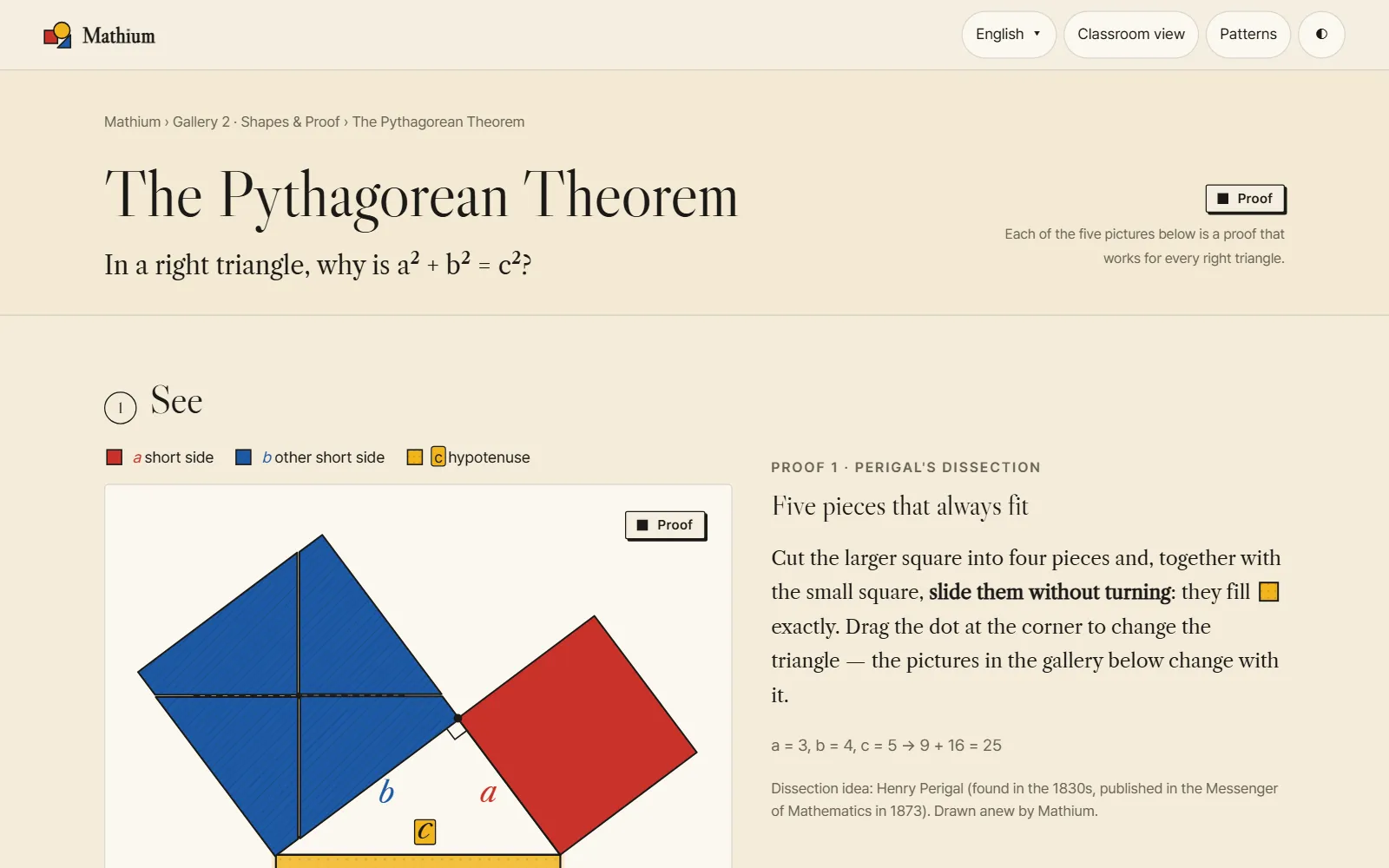
The Pythagorean Theorem exhibit asks its question up front: In a right triangle, why is a² + b² = c²? The badge next to it says Proof: each of the pictures below works for every right triangle.
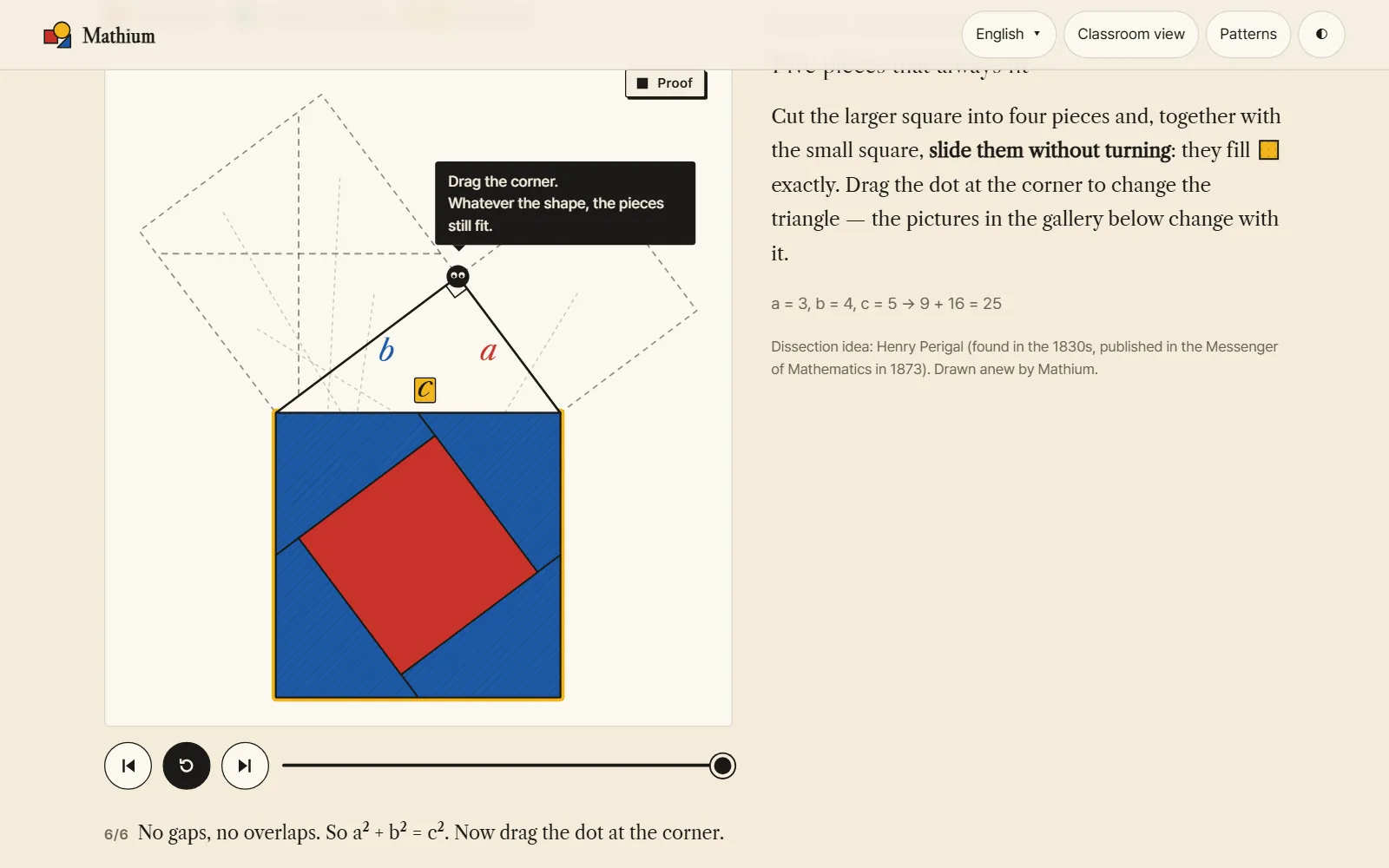
The first picture uses a dissection idea from Henry Perigal, drawn anew by Mathium. Step by step, a square stands on each side of the triangle, the larger square is cut into four identical pieces, and the pieces slide without turning into the corners of the square on the hypotenuse. The small square drops into the hole in the middle. The last step reads: No gaps, no overlaps. So a² + b² = c². Now drag the dot at the corner.
Drag it, and the triangle changes shape, yet the pieces still fit. That’s what makes it a proof rather than a lucky example. The exhibit sums up the idea behind every proof in its gallery: sliding or turning a piece does not change its area.
Play it, then run it 1,000 times
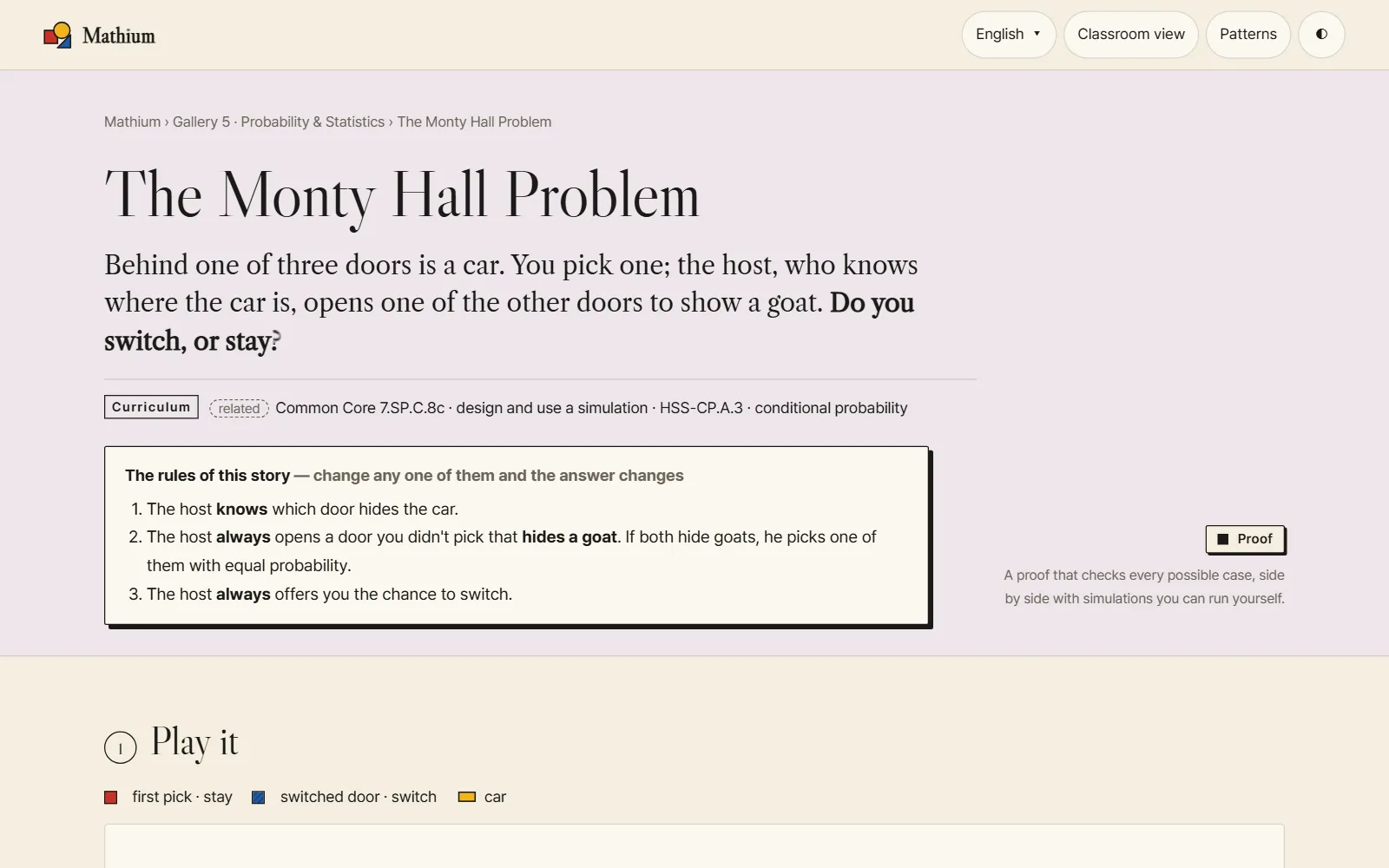
The Monty Hall Problem starts as a game. Behind one of three doors is a car. You pick one; the host, who knows where the car is, opens one of the other doors to show a goat. Do you switch, or stay?
A box spells out the rules, with a warning: change any one of them and the answer changes.
First you Play it yourself, one round at a time. The badge there is Example · simulation, because each round is a random experiment.
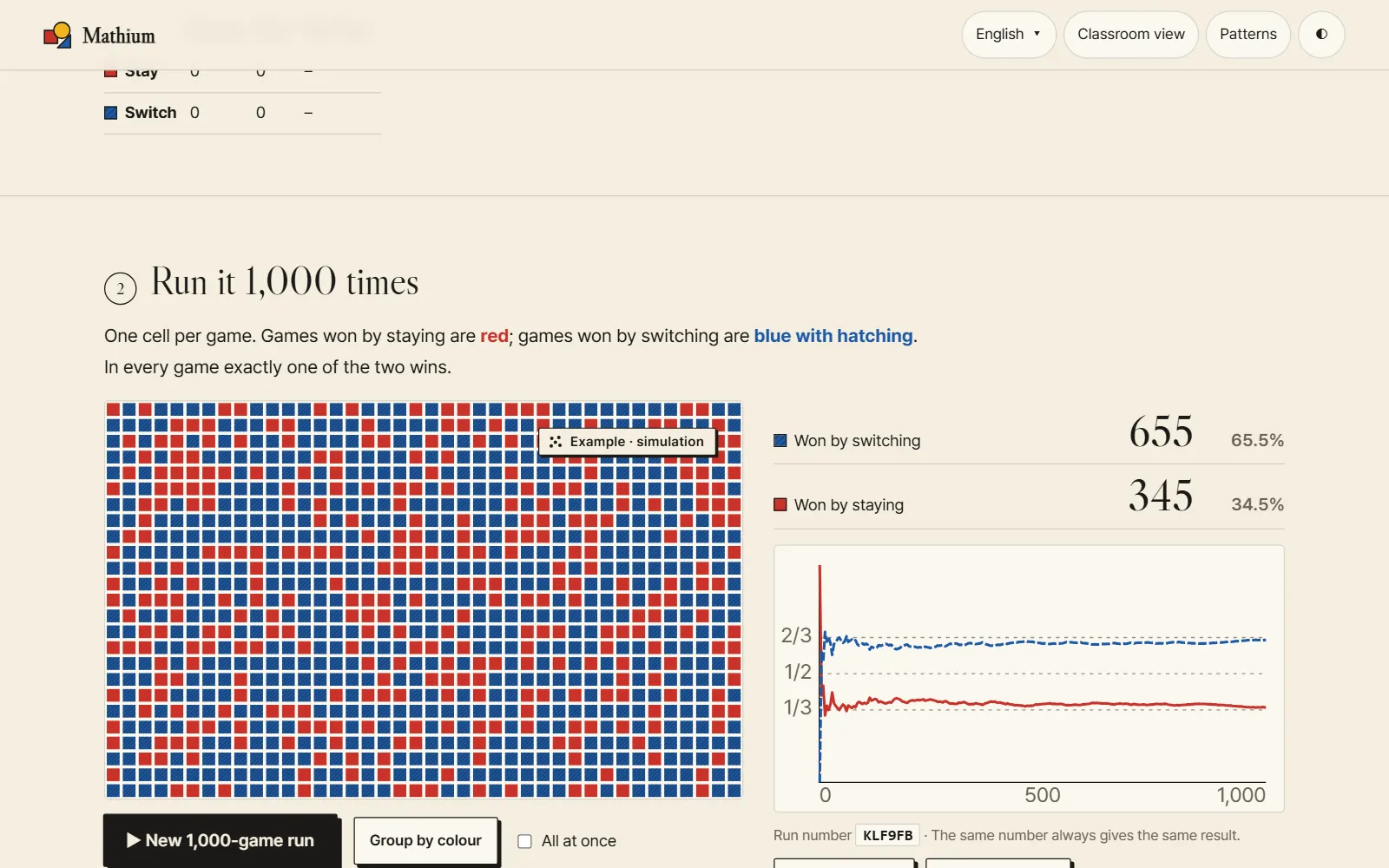
Then Run it 1,000 times. Each cell is one game: red if staying won, blue with hatching if switching won. In our run, blue covered roughly two thirds of the grid, and the chart beside it settled near 2/3 and 1/3. Run it again and the numbers shift a little, which is the point: it’s an experiment.
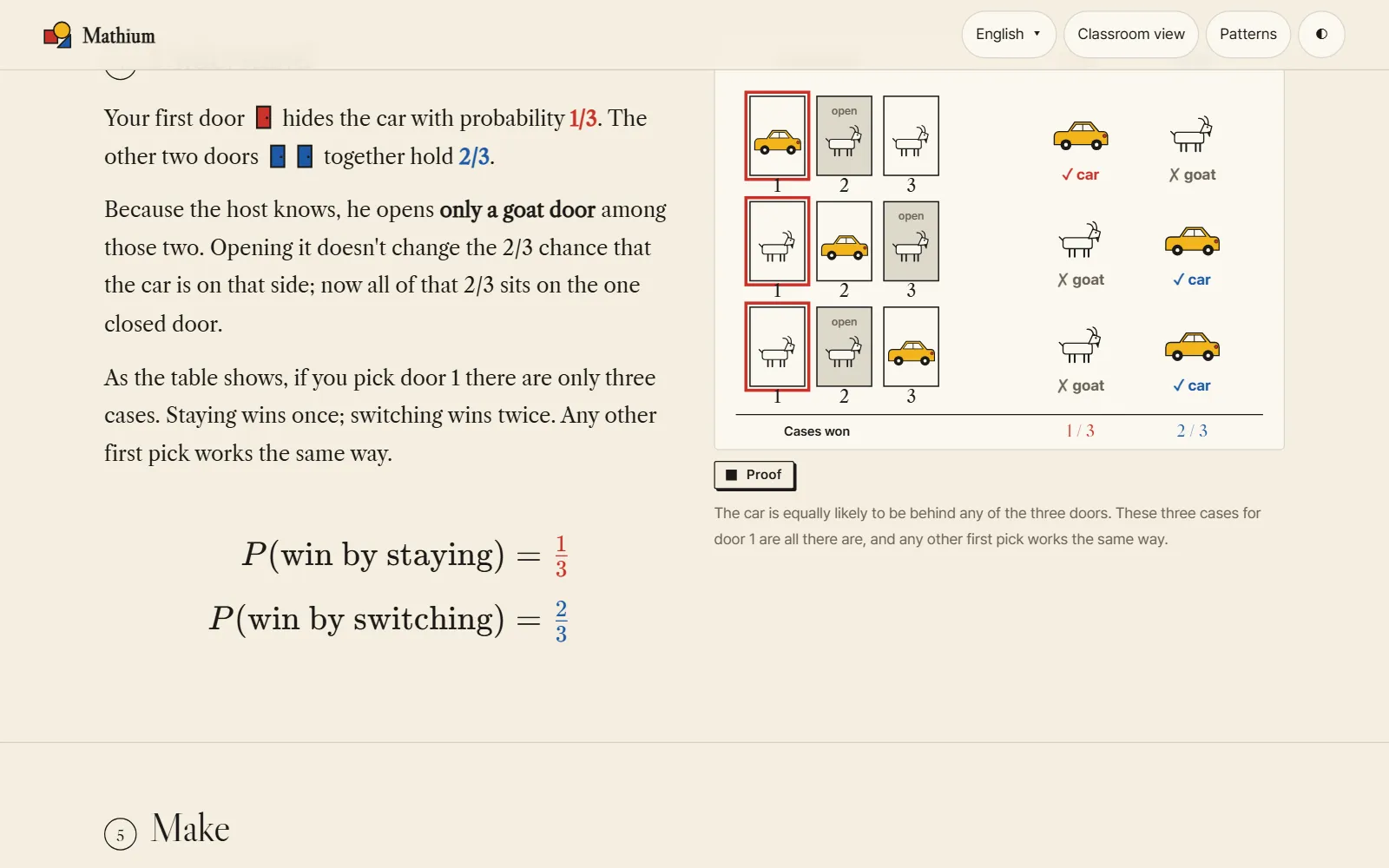
The proof comes in the Understand step. A table lists every possible case for a first pick of door 1: the car can be behind any of the three doors. Staying wins once, switching wins twice. This part wears the Proof badge. The 1,000 games made the answer believable; the table makes it certain.
Coming up next
If you enjoyed Mathium, its neighbours are Teadium, the online science museum, and Zoomputer, the zoom into a computer.
Next time: Lifium, where you pick two living things and find out how closely related they are.
Frequently asked questions
What is Mathium?
An online math museum from CodingTeading. Proofs and ideas move on screen, and you can drag them, change them and build them with blocks or JavaScript.
Is every picture in Mathium a proof?
No, and the site says so. Each scene carries a badge: Proof, Limit intuition, Example · simulation, Unsolved or Lying picture.
Which languages is it in?
English and Korean are the reference versions. The Japanese and Spanish versions are marked on screen as draft translations.
Do you need an account?
No. There is no sign-up, and your progress stays in your browser.